




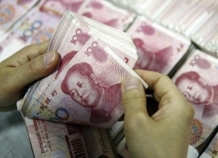
DUSHANBE, December 14, 2015, Asia-Plus – Tajikistan and China have reportedly launched a currency swap deal.
China’s news agency Xinhua reports a ceremony marking the start of the currency swap deal between China''s yuan and Tajikistan''s somoni was held in Urumqi, capital of northwest China''s Xinjiang Uyghur Autonomous Region on December 13.
The agreement is expected to further boost trade and investment and safeguard regional financial stability, Shohrat Zakir, chairman of the Xinjiang regional government, was quoted by Xinhua as saying at the ceremony.
We will recall that Tajikistan and China signed the currency swap agreement for the Chinese yuan and the Tajik somoni on September 3, 2015.
The deal, worth 3 billion yuan (equivalent to around 470 million U.S. dollars), will last for three years and can be extended if both sides agree.
Under the agreement, central banks of the two sides will be able to exchange a series of payments in one currency for equivalent amounts in another to facilitate bilateral trade settlements and provide liquidity support to financial markets.
The agreement is reportedly aimed at boosting trade and investment and safeguarding regional financial stability.
China’s central bank, People''s Bank of China (PBOC), noted in September that the move also marked the latest step in China''s efforts to promote the internationalization of the yuan. The PBOC has reportedly reached similar agreements with more than 30 countries and regions with a total value surpassing 3 trillion yuan.
Currency swap lines allow central banks to purchase and repurchase currencies from one another, which in turn makes it easier for banks in each relevant country to get hold of the underlying currencies. They are sometimes wheeled out in times of crisis to ensure liquidity keeps flowing around the markets. But they are not just there for the tough times. In China’s case, they reportedly make it easier to trade the yuan offshore. The extension of this agreement to China should ease investors’ concerns over the ability to dispose of large sums of the currency on short notice for cash management or trade settlement needs.
Meanwhile, the International Monetary Fund (IMF) has announced that China''s currency, the yuan, will join the fund''s basket of reserve currencies.
Currently just the US dollar, the euro, the yen and the pound are in the group.
The IMF said the yuan “met all existing criteria”'' and should become part of the basket in October 2016.
The yuan will now make up part of the IMF''s Special Drawing Rights (SDR) - an asset created by the IMF which serves almost as a currency.
China is the world''s second largest economy behind the US and asked for the yuan to become a reserve currency last year.


GBAO and Khatlon province complete spring draft target early
Chronicle of the month: March, 2026
Donald Trump states US ready to end war with Iran without a Deal
Kyrgyzstan launches domestic production of national currency
Windy April: weather forecast for Tajikistan
Tajikistan faces continued religious freedom challenges
The Judo Grand Slam in Dushanbe: what to expect
New developments in Isfara: schools, power substation, and coal mine opened
Iran claims drone factory in Tajikistan, but no evidence surfaces
Nuclear raid or breaking the blockade: why Trump wants thousands of Marines and paratroopers off the shores of Iran
All news