




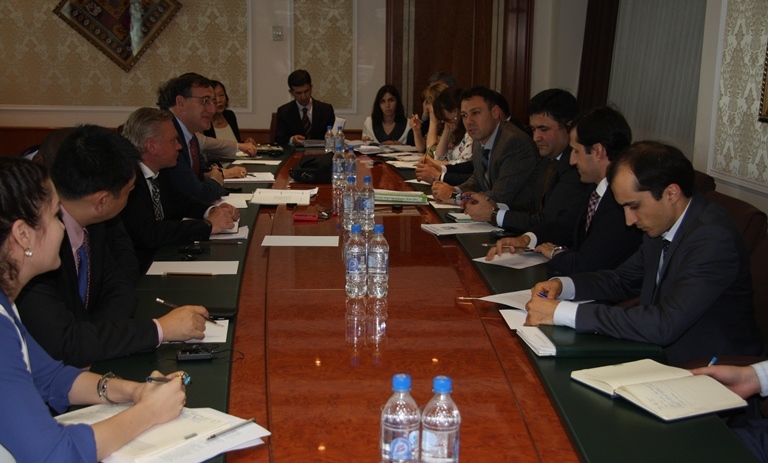
Top managers of the National Bank of Tajikistan (NBT) have asked the International Monetary Fund (IMF) to accelerate the process of discussions on a new three-year arrangement under the extended credit facility.
This issue was reportedly discussed here on May 23 at a meeting of the first deputy head of the Tajik central bank, Jamoliddin Nouraliyev, with the IMF mission, headed by Poll Ross.
In the course of the talks, the two sides exchanged views on development of the country’s economic policy, the current macroeconomic situation in Tajikistan, implementation of monetary and fiscal policy, development of the real sector of economy, economic reforms, and measures taken by the Tajik authorities to prevent negative impact of external factors.
They also discussed issues related to creation of conditions for recovery of the country’s banking system, regulation of distressed banks, improvement of legal foundation for control and regulation, and improvement of the level of financial transparency.
The possibility of launching a new IMF support program (Extended Credit Facility Arrangement) in Tajikistan has been discussed by the sides over the past four years, according to the NBT press center.
The previous three-year Extended Credit Facility program ended in Tajikistan in July 2012.
The Extended Credit Facility (ECF) provides financial assistance to countries with protracted balance of payments problems. The ECF was created under the Poverty Reduction and Growth Trust (PRGT) as part of a broader reform to make the Fund’s financial support more flexible and better tailored to the diverse needs of low-income countries (LICs), including in times of crisis. The ECF is the Fund’s main tool for providing medium-term support to LICs.
The ECF supports countries’ economic programs aimed at moving toward a stable and sustainable macroeconomic position consistent with strong and durable poverty reduction and growth. The ECF may also help catalyze additional foreign aid.


GBAO and Khatlon province complete spring draft target early
Chronicle of the month: March, 2026
Donald Trump states US ready to end war with Iran without a Deal
Kyrgyzstan launches domestic production of national currency
Windy April: weather forecast for Tajikistan
Tajikistan faces continued religious freedom challenges
The Judo Grand Slam in Dushanbe: what to expect
New developments in Isfara: schools, power substation, and coal mine opened
Iran claims drone factory in Tajikistan, but no evidence surfaces
Nuclear raid or breaking the blockade: why Trump wants thousands of Marines and paratroopers off the shores of Iran
All news
Авторизуйтесь, пожалуйста