




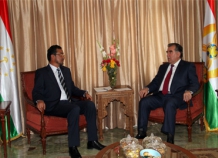
DUSHANBE, December 1, 2014, Asia-Plus -- Abdul Rauf Ibrahimi, Speaker of the Lower House (the House of the People or Wolesi Jirga) of the Afghan Parliament, is expected to pay an official visit to Tajikistan from December 3-6.
Afghan parliament speaker is reportedly scheduled to hold talks with Tajik Resident Emomamli Rahmon, Tajikistan’s Lower House (Majlisi Namoyandagon) Speaker Shukurjon Zuhurov and visit the Upper House (Majlisi Milli) of the Tajik Parliament.
State and prospects of further expansion of parliamentary cooperation between the two countries will be a major topic of the meetings, the source said.
Born in the Imam Sahib district of northern Kunduz province in 1962, Abdul Rauf Ibrahimi is ethnic Uzbek. He finished high school in 1979 before entering the Languages & Literature Faculty of Kabul University. But he joined the jihad when the former Soviet Union invaded Afghanistan. Following mujahidin’s victory, he was appointed as Sher Khan Dry Port director in 1993. Subsequently, he was appointed the commander of 3rd southern border police zone. After the collapse of the Taliban regime, he served as the commander of border police in 2002 before being elected as Emergency Loya Jirga member the same year. Ibrahimi was elected as Wolesi Jirga member from Kunduz in 2005. He won a parliamentary seat for the second time in 2010 when was elected as speaker of the Wolesi Jirga.
The House of the People or Wolesi Jirga is the lower house of the bicameral National Assembly of Afghanistan, alongside the House of Elders (Mesherano Jirga).
The House of the People is the chamber that bears the greater burden of law making in the country, as with the House of Commons in the Westminster model. It consists of 249 delegates directly elected by single non-transferable vote (SNTV). Members are elected by district and serve for five years. The constitution guarantees at least 64 delegates to be female. Kuchi nomads elect 10 representatives through a Single National Constituency.
The House of the People has the primary responsibility for making and ratifying laws and approving the actions of the president. The first elections in decades were held only in September 2005, four years after the fall of the Muslim fundamentalist Taliban regime, still under international (mainly UN and NATO) supervision. The 2010 Wolesi Jirga elections were held on September 18, 2010.


GBAO and Khatlon province complete spring draft target early
Chronicle of the month: March, 2026
Donald Trump states US ready to end war with Iran without a Deal
Kyrgyzstan launches domestic production of national currency
Windy April: weather forecast for Tajikistan
Tajikistan faces continued religious freedom challenges
The Judo Grand Slam in Dushanbe: what to expect
New developments in Isfara: schools, power substation, and coal mine opened
Iran claims drone factory in Tajikistan, but no evidence surfaces
Nuclear raid or breaking the blockade: why Trump wants thousands of Marines and paratroopers off the shores of Iran
All news