




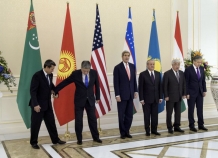
DUSHANBE, November 1, 2015, Asia-Plus – A joint meeting of Central Asian foreign ministers with Washington’s top diplomat that took place in Samarkand, Uzbekistan on November 1 has ended with adoption of a joint declaration.
U.S. Secretary of State John Kerry met with the five Central Asian Foreign Ministers: Kazakhstan Foreign Minister Erlan Idrisov, Kyrgyzstan Foreign Minister Erlan Abdyldayev, Tajikistan Foreign Minister Sirojiddin Aslov, Turkmenistan Foreign Minister Rashid Meredov and Uzbekistan Foreign Minister Abdulaziz Kamilov.
Uzbekistan’s foreign ministry says that the C5+1 meeting was inaugurated by Uzbek Foreign Minister Abdulaziz Kamilov.
The meeting participants reportedly exchanged views on prospects of further expansion of political trade and economic, cultural and humanitarian cooperation.
They also discussed a number of regional and international issues being of mutual interest, according to Uzbekistan’s foreign ministry.
Meanwhile, U.S. Department of State says that speaking at the meeting, Mr. Kerry noted that the United States “does support the sovereignty and the territorial integrity and the independence of each country that is represented here. And it’s very important for the countries of the region, in our judgment, to have healthy and mutually beneficial relations among yourselves, each of you, country to country, but also with neighbors and with all countries. And that’s really what brings us here.”
He noted that the United States wants to broaden and deepen its bilateral relationships through the region.
“We want to work together to support a common New Silk Road project. We look forward to working with you to improve border procedures and infrastructure, to remove unnecessary burdens on businesses, and to fight corruption,” U.S. top diplomat noted.
He said they are also moving forward on energy security and diversification. “And we’ve made a good start on projects like CASA-1000, which is going to create a regional electricity market from Central to South Asia. But everybody here understands we not only can do more, we have to do more, in order to drive home the urgency of growing economically in ways that are green and clean at the same time.”
Kerry noted that clean energy represents a remarkable market for the future and the United States is launching a new program called Smart Waters. This initiative will train the next generation of expert water managers and focus on river basin planning and sustainable water management.
According to him, the United States will also continue to support education in Central Asia by expanding the number of internships that are available for Central Asian students in the Fulbright and in the Muskie programs.
Mr. Kerry also noted that economic, social, and cultural initiatives are closely related to the quality of governance and the strength of democratic institutions.
The Joint Declaration of Partnership and Cooperation by the Five Countries of Central Asia and the United States of America, which is posted on the Department of State’s website, says the foreign ministers of the five Central Asian nations and the United States are committed to deepening cooperation, including through regular meetings in the “C5+1” format.
Respecting mutually their sovereignty, independence, and territorial integrity, the foreign ministers declare their commitment to:
“Improve mutually beneficial cooperation in regional trade, transport and communication, energy linkages, and transit opportunities, including upgrading existing facilities and promoting common rules and regulations to realize fully the region’s great economic potential;
“Enhance a favorable business climate in the region to attract foreign direct investment and facilitate local entrepreneurship and broaden and strengthen business and investment contacts among the Central Asian countries and the United States;
“Address environmental sustainability challenges, including through a new agreement in Paris that would contribute to the establishment of a climate regime that applies to all countries;
“Join efforts in addressing climate change by promoting clean energy and green technology in the region;
“Enhance cooperation to prevent and counter trans-boundary threats and challenges such as terrorism, trafficking of weapons of mass destruction, illicit drugs, and human beings;
“Support Afghanistan and its development as an independent, peaceful, thriving state, recognizing that the situation in Afghanistan remains an important factor in security and stability for the entire region;
“Contribute to global and regional nonproliferation efforts, including by respecting the provisions of the Treaty on a Nuclear-Weapons-Free Zone in Central Asia and pursuing entry into force of the Treaty’s Protocol;
“Develop closer cooperation in the humanitarian sphere and more extensive people-to-people ties, and encourage wider educational, cultural, and business exchanges; and
“Protect human rights, develop democratic institutions and practices, and strengthen civil society through respect for recognized norms and principles of international law, including the United Nations Charter, the Universal Declaration of Human Rights, the Declaration on Principles of International Law, and the Helsinki Final Act of the Conference on Security and Co-operation in Europe.


GBAO and Khatlon province complete spring draft target early
Chronicle of the month: March, 2026
Donald Trump states US ready to end war with Iran without a Deal
Kyrgyzstan launches domestic production of national currency
Windy April: weather forecast for Tajikistan
Tajikistan faces continued religious freedom challenges
The Judo Grand Slam in Dushanbe: what to expect
New developments in Isfara: schools, power substation, and coal mine opened
Iran claims drone factory in Tajikistan, but no evidence surfaces
Nuclear raid or breaking the blockade: why Trump wants thousands of Marines and paratroopers off the shores of Iran
All news