




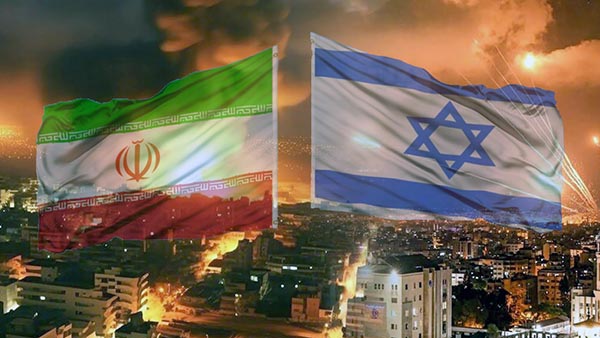
From June 13 to 25 of this year, the situation in the Middle East dramatically worsened with Israel's military aggression against the Islamic Republic of Iran. Soon after, the United States joined the military actions, while Tehran retaliated with strikes on Tel Aviv and U.S. military bases in the region. This conflict had a significant impact on public opinion in Tajikistan, where the population expressed solidarity with the Iranian people. Political analyst Muhammad Shamsuddinov shared his perspective on the causes of the “12-day war” and its implications for Central Asia.
Causes of Israel's military actions against Iran
Several key reasons can be identified for the war's outbreak. The first is tied to Iran's nuclear program, which Israel has repeatedly cited as a concern. A report from the International Atomic Energy Agency (IAEA) released on May 31 of this year provides crucial insight. According to the report, Iran's uranium production, during negotiations with the U.S. earlier this year, has become nearly suitable for nuclear weapons production. The IAEA stated that Iran possesses approximately 409 kilograms of uranium enriched to 60%. Since the IAEA's quarterly report in February 2025, the amount has increased by nearly 49%. Experts believe that around 42 kg of uranium enriched to 90% would be enough to develop nuclear weapons.
It is also important to note that during his first presidential term, U.S. President Donald Trump withdrew the United States from the 2015 Joint Comprehensive Plan of Action (JCPOA), which was signed between Iran and six world powers (U.S., UK, France, Germany, EU, Russia, and China) to limit Tehran's nuclear capacity in exchange for sanctions relief. In response, Iran refused to comply with the agreement and began expanding its nuclear capabilities.
A second reason for the war lies in the inefficacy of diplomatic efforts to resolve the issue of Iran’s nuclear program. After Trump assumed office again this year, he expressed interest in signing a new deal with Iran. However, five rounds of indirect negotiations between the U.S. and Iran appear to have reached an impasse. A key sticking point was the U.S. demand for “zero enrichment” of uranium and Tehran's ballistic missile program, which was one of the reasons for the JCPOA’s cancellation.
The third factor cited by Israeli officials was what they termed a “favorable moment.” These favorable circumstances included the near-total destruction of Hamas, the weakening of Hezbollah, and the fall of Bashar al-Assad's regime in Syria over the past year and a half. Iran's regional proxies, which were supported by Tehran, had previously surrounded Israel and served as a deterrent to Israeli actions. Their weakening and destruction significantly undermined Iran's regional position, affecting its security.
Another critical factor in this “favorable moment” was the Arab world’s shifting stance. Since Israel’s establishment, the Arab nations, especially Arab nationalists, viewed the state as illegitimate and sought its destruction. They also supported Palestinians in their struggle against Israel and for the creation of a Palestinian state. However, over recent decades, the “Arab threat” has been gradually neutralized, with former Arab leaders like those of Egypt, Iraq, Libya, and Syria moving into the background. The new leaders, mainly the Gulf monarchies, particularly Saudi Arabia, were no longer ideologically opposed to Israel and were prepared to abandon Arab claims to Palestine, including the establishment of a Palestinian state.
Thus, the combination of these factors led to Israel's and the U.S.'s military aggression against Iran.
How the war affected Central Asia
The war has led to a sharp increase in distrust in the region, which poses long-term risks for stability in the Middle East. On July 2, Iran's president signed a law suspending the country’s cooperation with the IAEA. Official Tehran stated that this step was forced by Israel's and the U.S.'s aggressive actions, as well as the transformation of the IAEA into a "political tool." A week earlier, Iran's Foreign Minister, Abbas Araghchi, hinted at the possibility of Iran leaving the Nuclear Non-Proliferation Treaty (NPT).
The uncertainty surrounding the Middle East, driven by the Iranian factor, continues to have a potentially destabilizing impact on areas beyond the region, particularly Central Asia. Iran shares a border with Central Asia, which could be threatened if further instability erupts in the country. This could lead to border incidents, refugee flows, and attempts by radical groups to use Turkmenistan’s territory as a transit zone.
Additionally, the intensification of armed formations and increased extremist activity in Iran's border provinces, such as Khorasan, Sistan, and Baluchestan, could lead to threats moving through the poorly protected sections of the border, especially in the absence of tight international control. It is noteworthy that over 2,000 people crossed the Turkmen-Iranian border during the conflict.
From an economic standpoint, Central Asian countries, which are already limited in their access to global sea routes, have suffered significant losses. These states place considerable importance on Iranian seaports as they seek access to the global market. Notably, the North-South transport and logistics corridor is crucial for the region’s economic activities, allowing Central Asian countries access to global sea routes through Iranian ports. Kazakhstan and Uzbekistan are key participants in this project, with Turkmenistan, Tajikistan, and Kyrgyzstan showing increasing interest in connecting to transportation and logistics flows.
This corridor is vital not only for economic reasons but also strategically, as it helps Central Asian countries reduce their dependence on northern and eastern transit routes, expanding trade connections with India, the Persian Gulf, and potentially even Africa. Additional benefits include increasing transit income and the creation of logistics centers and industrial zones along the route.
Another key transport corridor of interest to Central Asia is the Trans-Afghan South route, which is also tightly linked to the situation in Iran and the broader Middle East. This route, passing through Afghanistan, connects Central Asia with South Asia, especially Pakistan and India, and via the ports of Karachi and Gwadar, links the region to the Middle East, East Africa, and Indian Ocean markets.
A significant advantage of the Trans-Afghan route is its geographical brevity, offering the most direct land path from Tajikistan, Uzbekistan, and Turkmenistan to seaports. This offers Central Asian countries the opportunity to significantly reduce logistics costs and expedite deliveries southward. Several large infrastructure projects have been initiated to implement this concept, including the Mazar-i-Sharif-Kabul-Peshawar railway, promoted by Uzbekistan in cooperation with Afghanistan and Pakistan.
In November 2023, a memorandum was signed between Dushanbe and Tehran on international freight transportation and transit through Iran's Chabahar port. This reflects Tajikistan's interest in Persian Gulf ports, and the agreement includes four priority areas: simplifying procedures, reducing transit costs, attracting external cargo, investing in transportation infrastructure along the Chabahar route, and improving security and environmental standards.
For Tajikistan, access to Chabahar is a strategic step that goes far beyond simply opening a new route. Through Uzbekistan and Turkmenistan, Tajik products will gain direct access to the sea, bypassing traditional routes through Russia or Turkey. This access significantly boosts Tajikistan’s economic potential, with reduced costs and faster deliveries making exports more competitive.
However, the "12-day war" has damaged the attractiveness of these projects and raised concerns about their security, potentially affecting their implementation and the stability of Central Asia.
Regarding trade relations, the total trade turnover between Central Asia and Iran in 2024 amounted to over $1.5 billion, with Kazakhstan accounting for $340 million, Uzbekistan for about $500 million, and Tajikistan for $378 million. The free trade regime between Iran and the EAEU, which came into effect on May 15, 2025, and includes Kazakhstan and Kyrgyzstan, has led to tariff reductions and could potentially increase trade between Iran and Central Asia to $3–5 billion.
Notably, Iran signed 23 agreements with Tajikistan in January 2025, including contracts for developing cargo transportation through the Chabahar port, improving transport infrastructure, and reducing trade barriers. This agreement is expected to further boost trade between Iran and Central Asia.
If the conflict in the Middle East escalates, all these agreements and trade relations could face significant risks.
In conclusion, Uzbekistan’s President Shavkat Mirziyoyev aptly summed up the situation: “The focal point of instability in the world is once again expanding, and this will inevitably affect our region. If the escalation continues, trade relations and logistics routes, which had just begun to recover after the pandemic, will once again be under threat.”
 Руcский
