




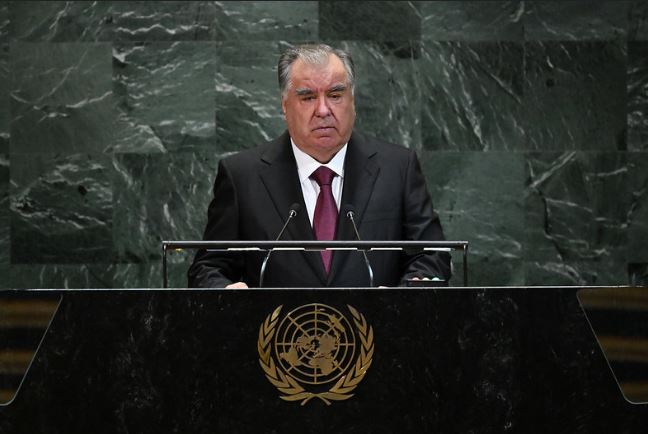
President of Tajikistan Emomali Rahmon yesterday delivered a wide-ranging speech at the General Debate of the 80th session of the United Nations General Assembly, highlighting key global challenges and urging stronger international cooperation.
The Tajik president’s official website says that in his address, President Rahmon framed the occasion as a vital moment to reflect on the organization’s founding principles amid growing global instability and uncertainty.
“The world is becoming increasingly complex,” Rahmon stated, emphasizing the critical role of the UN as a platform for dialogue, cooperation, and the promotion of international peace and security. He called on all countries to reaffirm their commitment to international law and to act collectively to uphold global order.
Rahmon devoted significant attention to the impacts of climate change, particularly on vulnerable countries such as Tajikistan. He noted the accelerating melting of glaciers and the degradation of marine ecosystems due to rising global temperatures. “We must not remain indifferent to the problems associated with the source of human life — water,” he said.
He reiterated Tajikistan’s leadership in global water initiatives, inviting member states to actively participate in the upcoming 2026 High-Level International Conference in Dushanbe, part of the ongoing “Dushanbe Water Process.”
The President also stressed the urgent need for equitable financial support to developing, mountainous, and landlocked nations. He expressed support for reforms to international financial systems and warned that many countries remain trapped in cycles of poverty, debt, and crisis exacerbated by COVID-19 and natural disasters.
Addressing rising geopolitical tensions, Rahmon called for enhanced adherence to international law and the peaceful resolution of conflicts through diplomatic means. He proposed that the UN General Assembly declare an “International Year of Legal Education” to promote global awareness and respect for legal norms.
In a new peace-focused initiative, Rahmon proposed the adoption of a special UN resolution declaring the “Decade for Strengthening Peace for Future Generations.” He argued that such a resolution could serve as a foundation for future-oriented global cooperation.
The President also touched on the ongoing conflict in the Middle East, calling for a sustainable ceasefire in Gaza and reaffirming support for the Two-State Solution as the only viable path to peace. He further emphasized Tajikistan’s support for stability and socio-economic development in neighboring Afghanistan.
Rahmon backed comprehensive reform of the United Nations under the "UN 80" and "UN 2.0" initiatives and endorsed the Secretary-General’s "Vision for a Modern UN System." He highlighted the “Pact for the Future” as a vital step toward global peace and development.
Rahmon underscored the transformative potential of digital technologies and artificial intelligence in achieving the Sustainable Development Goals, while warning of the risks posed by cybercrime. He called for cybersecurity to become a key element of global collective security efforts.
He also praised the UN Office of Counter-Terrorism for its role in supporting member states and emphasized the need for continued global cooperation against terrorism and emerging security threats.
Concluding his speech, President Rahmon reaffirmed Tajikistan’s commitment to multilateralism and its readiness to collaborate with UN member states in addressing the pressing issues of our time.
 Руcский
