




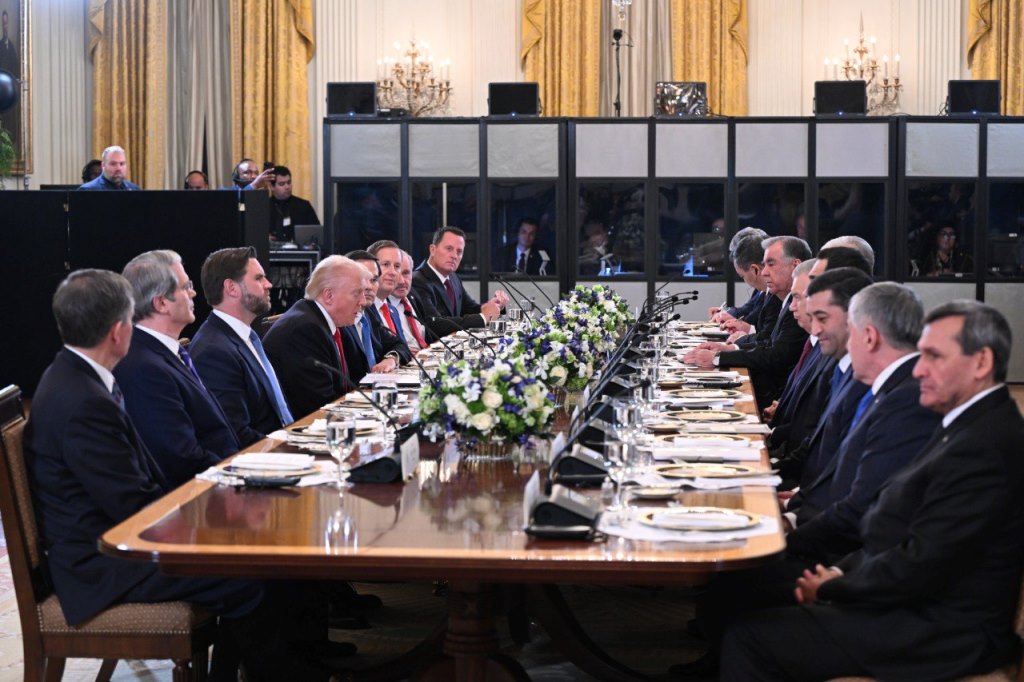
The growing ties between the United States and Central Asia could put the region in a difficult position: either risk displeasing Russia and China, or disappoint Trump and fall into even greater dependence on Moscow and Beijing.
The strengthening of Central Asia’s relationship with the United States may remain at the level of empty promises. However, it could also present the region with a tough choice: either provoke dissatisfaction from its traditional allies, Russia and China, or disappoint President Trump and fall into even deeper reliance on the very same Moscow and Beijing.
The outcomes of the "Central Asia – USA" (C5+1) summit are analyzed by Temur Umarov, a researcher at the Carnegie Endowment for International Peace.
Central Asia in the fall of 2025: Washington's focus
In the trends of autumn 2025 in Washington, Central Asia is a key focus. If anyone thought that Donald Trump’s brief meetings with the presidents of Uzbekistan and Kazakhstan, and the agreements they signed worth billions of dollars, were insufficient evidence of the seriousness of the US's intentions in the region, then the milestone C5+1 summit on November 6 should dispel those doubts.
For the first time in the history of their relations, all five Central Asian leaders and the US president gathered at the White House to celebrate a decade of cooperation in this format. For the heads of Central Asian states, this was either a rare trip (Emomali Rahmon last visited Washington in 2002, Shavkat Mirziyoyev in 2018), or their very first visit to Washington as presidents.
Never before had the US been so convincing in trying to demonstrate to Central Asia that cooperation with America could offset the inevitable irritation of two powerful neighbors. The question is how effective this new approach will be, and whether it will fall apart when faced with the harsh realities, as happened with Trump’s attempt to stop the Russia-Ukraine war.
An Ideological Shift
Attention from Washington has always been a valuable asset for the leadership of post-Soviet countries. It adds weight on the international stage and underscores who is in charge within the country. This is especially important for Central Asian states, where Russia and China are only willing to take the US seriously, and not Europe, Turkey, or any other mid-level power.
Thus, Central Asia has always been ready to adjust to the American ideological agenda, even when Washington’s rhetoric about promoting democracy was far removed from the real priorities of Central Asian leaders. Moreover, when Trump himself began dismantling organizations that irritated local regimes, such as USAID, NED, and Radio Free Europe, it automatically guaranteed him the warmest support from the region’s leaders.
After that, nothing could have pushed Central Asian leaders away from the White House, whether it was the president’s vague understanding of the region or the tariffs he imposed (25% for Kazakhstan, 10% for others). On the contrary, the Central Asian presidents became even more active in adjusting to Washington’s new agenda, publicly criticizing organizations like Soros, NGOs, and climate change initiatives.
By Trump’s first year in office, this adaptation bore fruit. In September, the US president held a brief meeting with the leaders of Uzbekistan and Kazakhstan on the sidelines of the UN General Assembly in New York, and now he hosted the C5+1 summit with all five Central Asian heads of state in Washington.
Not quite a departure, but the same approach
While representatives of the Trump administration emphasize that their approach to Central Asia is fundamentally different from that of their predecessors, the main topics of this summit are quite similar to those of previous C5+1 meetings. Even the dialogue with the region on rare earth metals, which Trump called key, was initiated during Joe Biden's presidency.
It was under Biden that the B5+1 business format was created to explore new investment opportunities, and C5+1 meetings were elevated to a presidential level—though these were held in New York, not the White House, as this one was.
Even the symbolism of the unprecedented first meeting at the White House was a little off. The official meeting lasted less than 40 minutes, half of which was spent on Trump’s responses to journalists' questions. The summit itself, the American side called only a “dinner.”
In other words, the foundation for the current rapprochement between the US and Central Asia was laid during Biden’s tenure, and Trump simply appears to be better at implementing these ideas because ideologically, he is much closer to the region’s leaders, who are eager to support his rhetoric about breakthroughs.
At the dinner, the Central Asian presidents competed to see who could best praise the American leader. The winner seemed to be Kazakhstan’s President Kassym-Jomart Tokayev, who declared that Trump was “a great leader and statesman sent by the heavens to return common sense and traditions that we all share to US politics, both domestic and foreign.”
How real is the breakthrough?
While the flowery rhetoric and excess of symbolism may create the impression that US-Central Asia relations are on the verge of reaching a new level of cooperation, achieving this in practice will be extremely difficult, even if both sides are genuinely willing.
Washington's geopolitical goals in the region have not changed—they are still focused on containing China and Russia. Trump, with his conservative ideas, may enjoy greater trust from Central Asian leaders than his predecessors. His special envoy for South and Central Asia is Sergio Gor, born in Tashkent. However, that alone is unlikely to be enough to overcome the objective limitations that have built up over decades.
Despite all the talk of huge investment potential, the US has yet to launch any large-scale projects in Central Asia comparable to China's investments under the Belt and Road Initiative or Russia’s recent plans to build nuclear power plants in Kazakhstan and Uzbekistan. Additionally, the Jackson-Vanik amendment for Central Asia was merely promised to be repealed “in the near future” during the meeting with Trump.
Moreover, even if Washington is keen to increase investments in the region, it will not be easy. The investment climate in Central Asia is not particularly favorable for Western partners, and the rules of the game are specific, requiring a deep understanding of the patron-client relationships between elites.
Sometimes, even a top-level green light does not guarantee success, as has been the case with the Americans. In 2020, SkyPower Global CEO Kerry Adler admitted that even Shavkat Mirziyoyev’s personal invitation to invest in Uzbekistan’s green energy sector led to nothing but multi-million dollar losses.
The problem with investments in Central Asia has never been the lack of desire from the US or Europe to invest in the region, but rather the local risks. Even countries that are well-versed in the regional business environment are not protected from asset seizures, as is regularly the case with Chinese and Russian investors.
Another challenge for potential American investors is the widespread involvement of Chinese and Russian projects in Central Asia’s economies. China is now present in nearly every sector and area of the region, which among other things hinders the advancement of Europe’s Global Gateway infrastructure initiative. Without developing a form of coexistence with China and Russia, advancing investments and influence in Central Asia will be nearly impossible.
The chances are also slim that the euphoria from Trump’s attention will push Central Asia to distance itself from Russia. Moscow remains the main guarantor of political regime security in the region and the main potential threat to their stability. For local leaders, it is too dangerous to risk their image as loyal allies in Moscow's eyes. After all, Trump is far away, and it is not certain he will be there for long, while Putin, if not forever, will certainly be around longer than four years.
Far or Close
However, the contrast between the optimistic atmosphere of meetings in the US and the modest practical results is fraught with risks for Central Asia itself. Trump may decide that the countries of the region are doing disproportionately little given the attention he is giving them and demand more—whether in regard to China or Russia. He may do so with an ultimatum, without delving into the nuances of Central Asia’s dependence on these two major neighbors.
Loyalty testing has not yet begun, but Washington is already gradually drawing Central Asian states into its key priorities. For example, Kazakhstan has expressed a desire to join the Abraham Accords, although it is unclear what this will change for a country that already has official diplomatic relations with Israel.
The rapprochement between Central Asia and the US may remain at the level of empty promises and utopian projects with attractive numbers. However, it could also force the region into a difficult decision: either provoke dissatisfaction from its traditional allies—Russia and China—or disappoint Trump and fall into even greater dependence on Moscow and Beijing.
For now, though, it seems that the region is not particularly concerned about this. The current task of Central Asian leaders is to extract as much symbolic capital as possible from Trump’s interest. And by the time practical successes need to be demonstrated, someone else might be in the White House.
 Руcский
