




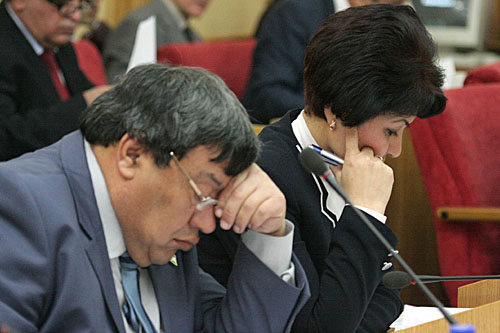
DUSHANBE, September 14, Asia-Plus -- Members of Tajikistan’s upper house (Majlisi Milli) of parliament have unanimously seconded the new edition of the country’s tax code.
A session of the Majlisi Milli, presided over by its head, Mahmadsaid Ubaidulloyev, was held in Dushanbe on September 14.
We will recall that the Majlisi Namoyandagon (Tajikistan’s lower chamber of parliament) endorsed the new edition of the country’s code on September 5.
A special commission was set up to work out the new Tax Code. The commission members included representatives from the government, private sector, and public associations. In all, the commission held 45 meetings. To work out the new edition of the tax code, the commission members reportedly studied an experience of Georgia and took into consideration views of experts from international financial institutions.
The number of articles in the Tax Code of Tajikistan was reduced from 271 to 229 and the new Tax Code offers the considerable reduction in the number of types of taxes by half -- from 21 to 10. Retail sales tax and highway use tax were abolished, while some types of taxes were unified.
For the purpose of supporting domestic producers the new tax code provides for exempting all the imported state-of-the-art equipment and technologies for production of commodities and services from paying value added tax (VAT) and customs duties. Besides, domestic enterprises dealing with processing wool, leather and farm produce will be exempted from paying all types of taxes during the first five years since they are launched irrespective of forms of property.
The new tax code is expected to be introduced gradually from 2013 to 2017.
The Majlisi Milli members also seconded the government’s proposal to rename eleven settlements in the Bokhtar district, Khatlon province.
Under the Constitution, the Majlisi Milli shall second the law by a majority of votes of the total number of its members. In the event the Majlisi Milli doesn’t second the law, it shall be considered at the Majlisi Namoyandagon repeatedly. If the Majlisi Namoyandagon does not agree with decision of the Majlisi Milli, the law shall be considered to be adopted if Majlisi Namoyandagon by not less than two-thirds of the votes confirms the decision previously adopted by it.


GBAO and Khatlon province complete spring draft target early
Chronicle of the month: March, 2026
Donald Trump states US ready to end war with Iran without a Deal
Kyrgyzstan launches domestic production of national currency
Windy April: weather forecast for Tajikistan
Tajikistan faces continued religious freedom challenges
The Judo Grand Slam in Dushanbe: what to expect
New developments in Isfara: schools, power substation, and coal mine opened
Iran claims drone factory in Tajikistan, but no evidence surfaces
Nuclear raid or breaking the blockade: why Trump wants thousands of Marines and paratroopers off the shores of Iran
All news
Авторизуйтесь, пожалуйста