




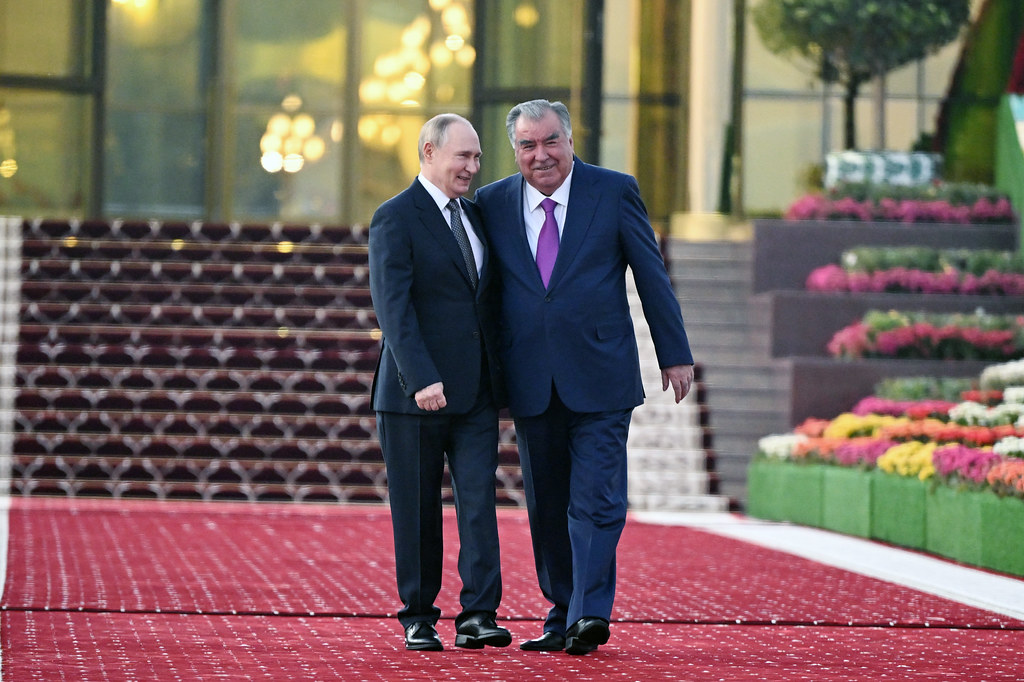
Tajik President Emomali Rahmon has approved a draft agreement with the Russian Federation concerning the legal status of representations of competent authorities dealing with internal affairs and migration. The decree and draft agreement were published on the Ministry of Justice of Tajikistan’s legal information portal.
The document aims to strengthen cooperation in the fight against transnational crime, the illegal drug trade, and migration-related issues. Under the agreement, the representations will work with the relevant authorities in the host country, exchange information, consult citizens, and protect their rights.
As part of the agreement, Tajikistan will open representations of the Ministry of Internal Affairs and the Ministry of Labor, Migration, and Employment in Moscow, while Russia will establish its Ministry of Internal Affairs representation in Dushanbe.
These representations will operate under the general leadership of their respective diplomatic missions and will perform several key functions, including:
- Facilitating interaction between the internal affairs agencies of both countries in the fight against transnational crime and illegal drug trafficking;
- Engaging in information exchange regarding legislation on internal affairs and migration;
- Coordinating cooperation in labor migration issues, protecting citizens’ rights, and analyzing migration legislation in the host country;
- Providing legal and consultative assistance to citizens on issues within their competence.
Additionally, the representations will participate in drafting bilateral agreements aimed at regulating migration and improving cooperation in crime-fighting efforts.
Staff members, including administrative and technical personnel, will be accredited by the host country’s Ministry of Foreign Affairs and will enjoy diplomatic privileges and immunities as per international law. The properties, premises, archives, and correspondence of the representations will be protected under the same inviolability guarantees as those of diplomatic missions.
The agreement will remain in effect indefinitely and will come into force once both sides complete the necessary domestic procedures. It can be terminated through mutual notification, but not earlier than six months after receiving the notification.
The Tajik Ministry of Internal Affairs has been tasked with signing the agreement, while the Ministry of Foreign Affairs will work with Russia to determine the date and place of the signing.
Earlier, on October 9, during his visit to Dushanbe, Russian President Vladimir Putin emphasized that law enforcement agencies from both countries should collaborate on their respective territories. This approach would allow Tajik law enforcement officers to see first-hand what is happening and participate in administrative decisions alongside their Russian counterparts.
“When Tajik law enforcement officials are involved, it is perceived differently by the Tajik citizens in Russia. It’s one thing when the police demand adherence to laws, and another when Tajik authorities themselves are involved. This builds trust on both sides and improves the effectiveness of the work,” said Putin.
 Руcский
