




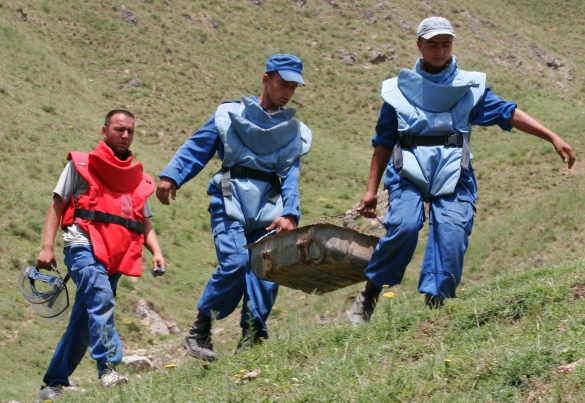
DUSHANBE, August 29, 2011, Asia-Plus -- The first victim of Uzbek government’s unilateral decision to mine rural border areas with Tajikistan was reported on August 29, 2000.
The Mine Action Cell (TMAC) director Jonmahmad Rajabov says 74 Tajik national have been killed and 87 other Tajik citizen shave been wounded in mine explosions on the Tajik-Uzbek border. Aimed at hindering the movement of Islamic militants in the area, it is Tajik civilians of these rural border areas who suffer from Tashkent’s security initiative, the TMAC director noted.
According to him, Tajikistan’s Foreign Ministry has repeatedly applied to the Uzbek authorities with solicitation to discuss that problem and consider the issue of handover of the map of minefields. “Unfortunately, Tashkent has responded to this request and we are currently carrying out work to detect mined areas by ourselves,” said Rajabov, “Recently, two our demining teams worked in Asht district and we are currently analyzing their reports. They will continue survey in other districts after the September holidays.”
In January 2002, the Red Crescent Society of Tajikistan also launched a special program, entitled Raising Awareness of Mines and Unexploded Ordnance. The goal was to cut the number of casualties by teaching local people in affected areas some rules of safe conduct. Rajabov said fewer people had stepped on mines since the project was launched
To-date, Tajik demining teams have to clear an area of little more than nine million square meters of land mines and unexploded ordnances (UXOs).
Most land mines in Tajikistan were laid during the devastating five-year civil war, which ended in 1997. In some areas the mines still pose a deadly threat as well as a major impediment to effective land use.
Additional mines were laid along the Tajik-Uzbek border by the authorities in Tashkent. The action was reportedly taken to stave off incursions by the Islamic Movement of Uzbekistan (IMU), listed by the US State Department as a terrorist organization which trained in and operated from Tajik territory. To date, not one Uzbek militant has been blown up by these mines, while casualties among the civilian Tajik population have increased. Most of the victims were women and children who were gathering firewood along the border as well as shepherds pasturing cattle in the areas. Almost all who have survived have become disabled for life.


GBAO and Khatlon province complete spring draft target early
Chronicle of the month: March, 2026
Donald Trump states US ready to end war with Iran without a Deal
Kyrgyzstan launches domestic production of national currency
Windy April: weather forecast for Tajikistan
Tajikistan faces continued religious freedom challenges
The Judo Grand Slam in Dushanbe: what to expect
New developments in Isfara: schools, power substation, and coal mine opened
Iran claims drone factory in Tajikistan, but no evidence surfaces
Nuclear raid or breaking the blockade: why Trump wants thousands of Marines and paratroopers off the shores of Iran
All news
Авторизуйтесь, пожалуйста