




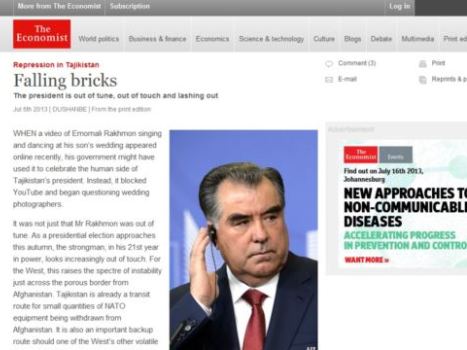
DUSHANBE, July 8, 2013, Asia-Plus – An article entitled “Repression in Tajikistan. Falling Bricks” that pos posted on The Economist’s website on July 6 notes that as a presidential election approaches this autumn, President Rahmon looks increasingly out of touch.
“For the West, this raises the specter of instability just across the porous border from Afghanistan. Tajikistan is already a transit route for small quantities of NATO equipment being withdrawn from Afghanistan. It is also an important backup route should one of the West’s other volatile partners in the region prove unreliable.
“Tajikistan has never held an election judged fair by credible observers. But this year’s vendetta against the government’s critics has been especially vicious. In March one of them vanished without a trace. In April an Islamic opposition figure was brutally beaten. In May Zaid Saidov, a former industry minister who is now in business, was arrested on an eight-year-old corruption charge, after launching a political party.
“Now he is being defamed in the press and held with limited access to his lawyer. His party colleagues, some of Tajikistan’s best minds, are being harassed: warned to watch for falling bricks. The death threats, from anonymous callers and affable agents of the spy service (still known, unaffectionately, as the KGB), extend to their children. “It hasn’t been this bad in the 20 years of independence,” says Nuriddin Karshibaev, head of a press-freedom lobby, who sees the Saidov case as a warning to the middle class to shun politics.
“Mr. Rahmon likes to prove his pluralist credentials by pointing to the opposition Islamic Revival Party and a few critical newspapers. But the party has been defanged by stolen elections, threats and violent attacks on its leaders. In April, when it tried to hold an international conference, the regime stopped issuing visas at the airport until the meetings were over.
“Meanwhile, state television dutifully follows Mr. Rahmon through tedious ceremonies where flag-waving children read poems in his honor. Mr. Rahmon has one saving grace: helping end the civil war that killed between 50,000 and 100,000 in the 1990s (the population is now nearly 8 million). Tajiks have fared better in Tajikistan than their ethnic kin in Afghanistan.
“Yet the president’s reputation as a peacemaker may no longer be enough. The post-war generation cannot find jobs. The economy is held hostage by the president’s family, with its penchant for seizing successful businesses. As a Western diplomat sums it up: “This is a feudal system where the elites are stuffing their pockets while they still can.”
“Mr. Rahmon seems to have one eye on his rocky ties with Russia. Conscious of Russia’s history of meddling in its former Central Asian satrapies, he fears it might support an alternative, such as Mr. Saidov. The Kremlin is unhappy with Mr. Rahmon, who has been stalling on extending the lease for Russia’s largest non-naval military base abroad. Several other critics live in Russia, nagging Mr. Rahmon over satellite television and the internet.
“Russia has another powerful lever. At least 1 million Tajiks work there, including, by some counts, half of Tajikistan’s working-age men. Their remittances add up to the equivalent of almost half of GDP. Mr. Rahmon knows that if Russia loses patience, a few planeloads of deported Tajik migrants would wreak havoc in the capital, Dushanbe.”


GBAO and Khatlon province complete spring draft target early
Chronicle of the month: March, 2026
Donald Trump states US ready to end war with Iran without a Deal
Kyrgyzstan launches domestic production of national currency
Windy April: weather forecast for Tajikistan
Tajikistan faces continued religious freedom challenges
The Judo Grand Slam in Dushanbe: what to expect
New developments in Isfara: schools, power substation, and coal mine opened
Iran claims drone factory in Tajikistan, but no evidence surfaces
Nuclear raid or breaking the blockade: why Trump wants thousands of Marines and paratroopers off the shores of Iran
All news
Авторизуйтесь, пожалуйста