




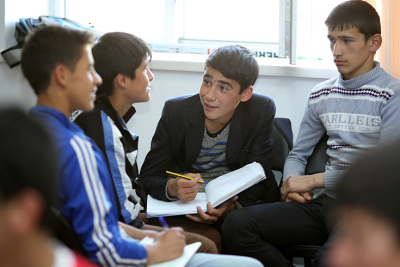
DUSHANBE, February 13, 2015, Asia-Plus – A new World Bank report says more equitable and efficient higher education is needed to meet labor market demands in Tajikistan.
The report analyzes the efficiency, equity, and effectiveness of higher education in Tajikistan, and suggests policy reforms that could be undertaken to enhance the quality and relevance of higher education for labor market demands.
The report, in particular, notes that the first decade of the 21st century saw a rapid expansion and development of higher education in Tajikistan, which has started to stabilize in recent years. Today, the country’s enrollment rate in tertiary education (university and college) is 22 percent which – although lower than most countries in the Europe and Central Asia region – is much higher than countries at a similar level of economic development.
Nevertheless, some important challenges remain. For instance, access to higher education is highly inequitable – by gender, socio-economic status, and geographical location. Less than one third (30 percent) of students in higher education are female. Two thirds (65 percent) of all students come from households in the top 40 percent of the income range, while only 16 percent come from the bottom 40 percent.
It is widely accepted that regardless of a country’s level of economic development the benefits of higher education are multiple and diverse. For example, university and college educated individuals are more likely than those without such an education to find a stable job in the formal sector, earn a higher income, and avoid being trapped in poverty.
Tajikistan’s government has set-out a clear vision for the future of higher education: as a tool for human capital formation that can further enhance economic growth in a rapidly changing world. To this end, the National Strategy for Education Development Up To 2020 aims to modernize higher education so that it is geared specifically towards professionally-oriented skills that can better meet evolving labor market demands.
The government is also focused on joining the Bologna Declaration, with a view to integrating with the European Higher Education Area. However, major reforms still need to be developed, adopted and operationalized – including the establishment of a credible quality assurance system and national qualifications framework. Higher education governance, quality assurance, teaching, learning, and student assessment are also areas in need of attention.


GBAO and Khatlon province complete spring draft target early
Chronicle of the month: March, 2026
Donald Trump states US ready to end war with Iran without a Deal
Kyrgyzstan launches domestic production of national currency
Windy April: weather forecast for Tajikistan
Tajikistan faces continued religious freedom challenges
The Judo Grand Slam in Dushanbe: what to expect
New developments in Isfara: schools, power substation, and coal mine opened
Iran claims drone factory in Tajikistan, but no evidence surfaces
Nuclear raid or breaking the blockade: why Trump wants thousands of Marines and paratroopers off the shores of Iran
All news