




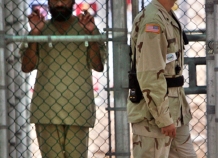
DUSHANBE, November 11, 2015, Asia-Plus – The OSCE Office for Democratic Institutions and Human Rights (ODIHR) has criticized the United States Government for sending three Guantanamo prisoners to Tajikistan despite the Tajik government allegedly threatening those individuals during visits to Guantanamo in 2002 and 2003.
The OSCE/ODHR Report Human Rights Situation of Detainees at Guantanamo , in particular, notes that the US government in 2007 sent three detainees, Rukniddin Sharipov, Sobit Vohidov and Mazhariddin Fayzullo, to Tajikistan despite the Tajik government allegedly threatening those individuals during visits to Guantanamo in 2002 and 2003.
At the time of their transfer, the United States Bureau of Democracy, Human Rights and Labor’s 2006 report explained that Tajikistan’s security officials engaged in “systematic beatings, sexual abuse, and electric shock to extort confessions during interrogations” and that courts regularly allowed confessions induced from torture and beatings. It also reported that members of extremist Islamist political organizations were tortured in Tajikistan. The United States’ own reporting prior to their transfer to Tajikistan demonstrates that the US government was aware that torture was used during interrogations and that Islamist extremists were tortured in police custody. Based on these factors, ODIHR believes that the United States knew or ought to have known that substantial grounds existed for believing that the three detainees, who it accused of being members of an extremist Islamist terrorist group, would likely be subjected to torture or ill-treatment if returned to Tajikistan.
Sharipov and Vohidov were subsequently prosecuted in Tajikistan and sentenced to 17 years in prison after they were reportedly coerced into signing confessions through the use of torture. They continue to be held in prison, according to the OSCE/ODIHR report.
This report presents the findings of the comprehensive human rights assessment of the situation of detainees at the Guantánamo Bay detention facility, conducted by the Office for Democratic Institutions and Human Rights (ODIHR) of the Organization for Security and Co-operation in Europe (OSCE) from 2012 to 2015. This assessment was carried out in line with ODIHR’s mandate to support the OSCE participating States in developing and implementing human rights-compliant measures to prevent and counter terrorism and to monitor the implementation of their human dimension commitments.
The human rights assessment carried out by ODIHR consisted of in-depth research, two fact-finding missions to the United Sates in February and September 2014, and a series of interviews with a broad range of stakeholders. In September 2014, ODIHR held eight interviews with relevant US officials from the Departments of State, Defense and Justice and the Presidential Administration, including senior officials involved in the proceedings before the military commissions. ODIHR also met with 14 representatives of nongovernmental organizations, 25 military and civilian lawyers representing Guantánamo detainees in past and current cases before the military commissions, habeas corpus proceedings or before the Periodic Review Board (PRB), five former detainees as well as medical and legal experts working on Guantanamo.
The report analyzes the compliance with international human rights standards of the detention, conditions of confinement and treatment of detainees at Guantanamo and the proceedings before the military commissions. It also explores the challenges related to the closure of the detention facility, accountability for alleged human rights violations both at Guantanamo and in the Central Intelligence Agency (CIA) Rendition, Detention and Interrogation (RDI) program as well as the right to redress in cases of victims of arbitrary detention, torture and/or ill-treatment, addressing in that respect the human rights obligations of not only the United States but also other concerned OSCE participating States. The report covers relevant developments up until August 31, 2015.


GBAO and Khatlon province complete spring draft target early
Chronicle of the month: March, 2026
Donald Trump states US ready to end war with Iran without a Deal
Kyrgyzstan launches domestic production of national currency
Windy April: weather forecast for Tajikistan
Tajikistan faces continued religious freedom challenges
The Judo Grand Slam in Dushanbe: what to expect
New developments in Isfara: schools, power substation, and coal mine opened
Iran claims drone factory in Tajikistan, but no evidence surfaces
Nuclear raid or breaking the blockade: why Trump wants thousands of Marines and paratroopers off the shores of Iran
All news