




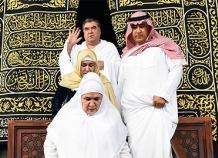
DUSHANBE, January 5, 2016, Asia-Plus – President Emomali Rahmon together with his wife, some of his children and immediate relatives performed Umrah rituals today, according to the Tajik president’s official website.
The Saudi Press Agency ( SPA ) reports Tajik President Emomali Rahmon arrived in Jeddah on January 4 on his way to perform Umrah rituals.
He was reportedly received at King Abdulaziz International Airport by Prince Mishaal bin Majed bin Abdulaziz, Governor of Jeddah; Mayor of Jeddah Dr. Hani bin Mohammed Abu Ras; and a number of officials.
The Umrah is a pilgrimage to Mecca, Saudi Arabia, performed by Muslims that can be undertaken at any time of the year, in contrast to the Hajj. In Arabic, Umrah means “to visit a populated place.” In the Sharia, Umrah means to perform Tawaf (circling) round the Kaaba and Sa’i between Al-Safa and Al-Marwah ( two small hills now located in the Masjid al-Haram in Mecca,), after assuming Ihram (a sacred state), either from a Migat like Zu ''l-Hulafa, Juhfa, Qarnu ''l-Manāzil, Yalamlam (a city in the Mecca Province of Saudi Arabia in the Yalamlam Valley), Zāt-i-''Irq, Ibrahīm Mursīa, or a place in Hill. It is sometimes called the ''minor pilgrimage'' or ''lesser pilgrimage'', the Hajj being the ''major'' pilgrimage and which is compulsory for every able-bodied Muslim who can afford it. The Umrah is not compulsory but highly recommended.
The pilgrim performs a series of ritual acts symbolic of the lives of Ibrahim (Abraham) and his second wife Hajar, and of solidarity with Muslims worldwide.
These acts of faith are:
- Perform a tawaf, which consists of circling the Kaaba seven times in an anticlockwise direction. Men are encouraged to do this three times at a hurried pace, followed by four times, more closely, at a leisurely pace;
- Perform a sa''i, which means rapidly walking seven times back and forth between the hills of Safa and Marwah. This is a re-enactment of Hajar''s frantic search for water. The baby Ishmael cried and hit the ground with his foot (some versions of the story say that an angel scraped his foot or the tip of his wing along the ground), and water miraculously sprang forth. This source of water is today called the Well of Zamzam;
- Perform a halq or taqsir, meaning a cutting of the hair. A taqsir is a partial shortening of the hair, whereas a halq is a complete shave of the head, except for women, as they cut a little amount of hair instead.
These rituals complete the Umrah, and the pilgrim can choose to go out of ihram. Although not a part of the ritual, most pilgrims drink water from the Well of Zamzam. Various sects of Islam perform these rituals with slightly different methods.
The peak times of pilgrimage are the days before, during and after the Hajj and during the last ten days of Ramadan.


GBAO and Khatlon province complete spring draft target early
Chronicle of the month: March, 2026
Donald Trump states US ready to end war with Iran without a Deal
Kyrgyzstan launches domestic production of national currency
Windy April: weather forecast for Tajikistan
Tajikistan faces continued religious freedom challenges
The Judo Grand Slam in Dushanbe: what to expect
New developments in Isfara: schools, power substation, and coal mine opened
Iran claims drone factory in Tajikistan, but no evidence surfaces
Nuclear raid or breaking the blockade: why Trump wants thousands of Marines and paratroopers off the shores of Iran
All news