




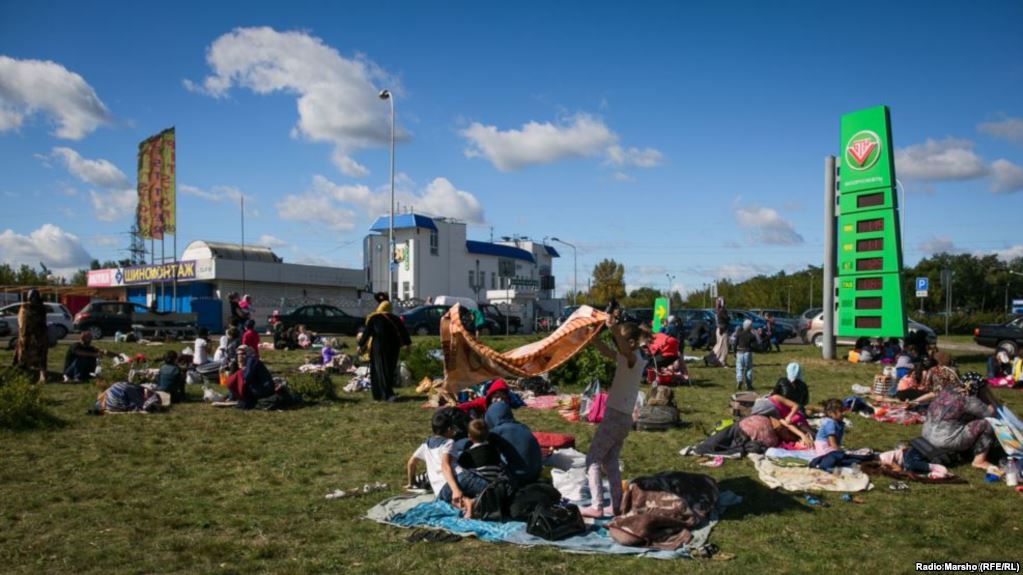
The Warsaw-based Helsinki Foundation for Human Rights says that Warsaw has refused to give asylum to dozens of Tajik nationals and hundreds of Tajik nationals have been stranded at the border of this European country, according to the Central Asian News Service.
Daniel Witko, a lawyer with the Warsaw-based Helsinki Foundation for Human Rights, noted that many of the asylum seekers do not have visa, and therefore, they have been forced stay in the border zone for months.
According to him, the number of Tajik nationals wanting to enter Europe through its eastern that is Polish gates is unknown. But Tajiks who managed to get into the country say some 100-200 refugees from Tajikistan been stranded at the Belarusian-Polish border alone.
EurasiaNet.org reported on January 17 that according to data provided by Poland’s Office for Foreigners, a growing number of Tajik nationals began claiming asylum toward the end of 2015, as the crackdown back home was picking up steam.
The number of claims reportedly peaked last May, when 129 individuals applied for international protection — compared with 18 the same month a year earlier. In recent months, the number has been declining. Only four asylum applications were registered in November. At the same time, according to data provided by the Polish Border Guard, between January and October 2016, 5,503 Tajik nationals were denied entry into Poland, a surge from 1,896 over the same period in 2015.
EurasiaNet.org reported that according to the data provided by Poland’s Office for Foreigners, in 2016, 13 Tajik nationals were granted refugee status or another form of international protection in Poland. Another 633 applications were discontinued, most of them due to the absence of the applicant. Six people were sent back to Tajikistan.
Meanwhile, Human Rights Watch (HRW) has also expressed concern about the fate of asylum-seekers strained at Polish border. The HRW report, Poland: Asylum Seekers Blocked at Border, which was released on March 1, in particular, notes that Polish authorities routinely deny asylum seekers at the Belarus-Poland border the right to apply for asylum and instead summarily return them to Belarus. Since 2016, large numbers of asylum seekers, mostly from the Russian Republic of Chechnya, but also from Tajikistan and Georgia, have tried to apply for asylum in Poland at the border with Belarus, according to the report.
The numbers reportedly peaked during spring and summer 2016, with up to 200 to 300 asylum seekers each day, down to 40 to 80 a day during the winter. When they arrive at the border station by train from the Belarus city of Brest, Polish border guard officials briefly interview passengers seeking asylum. Usually all but a handful are denied entry into Poland and the ability to apply for asylum. The written decisions handed to asylum seekers usually refer to whether the person has a visa or entry residency permit, without comment on or acknowledgement of the person’s protection claim. Those denied access are sent back by train to Belarus the same day.
Belarus has provisions in law for an asylum system, but in practice it does not offer meaningful protection. The report says that Tajiks, many of whom have experienced abuse in Tajikistan and fear deportation or harassment from Tajik security forces in Russia, cannot get effective protection in Belarus, which views Russia as a safe third country.
In 2016, Poland’s recognition rate for asylum seekers from Russia (including Chechens) was 5.6 percent and for those from Tajikistan, 10.5 percent. This compares with average across the EU 28 member states of 19 percent for asylum seekers from Russia and 27.5 percent for those from Tajikistan.


GBAO and Khatlon province complete spring draft target early
Chronicle of the month: March, 2026
Donald Trump states US ready to end war with Iran without a Deal
Kyrgyzstan launches domestic production of national currency
Windy April: weather forecast for Tajikistan
Tajikistan faces continued religious freedom challenges
The Judo Grand Slam in Dushanbe: what to expect
New developments in Isfara: schools, power substation, and coal mine opened
Iran claims drone factory in Tajikistan, but no evidence surfaces
Nuclear raid or breaking the blockade: why Trump wants thousands of Marines and paratroopers off the shores of Iran
All news
Авторизуйтесь, пожалуйста