




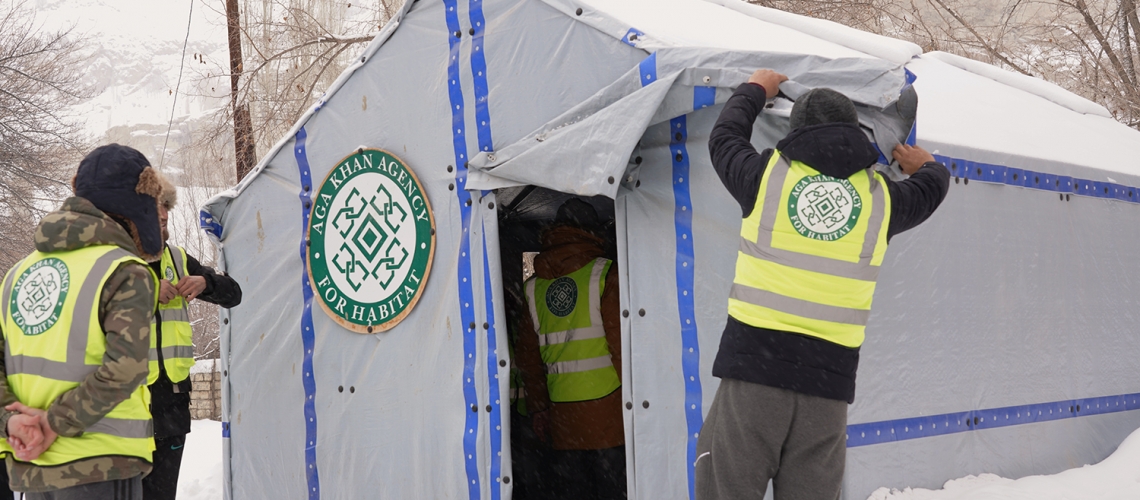
In 2020, the Aga Khan Agency for Habitat (AKAH), participated in a pilot project with Better Shelter, a Swedish social enterprise, SEEDS India, and other partners, to test Structure, a modular, low-cost emergency shelter which can be upgraded with local materials.
According to the Aga Khan Development Network, each partner organization received flat-packed Structure units from Better Shelter to test in different locations in Afghanistan, India and Tajikistan. AKAH reportedly deployed these units in Afghanistan and Tajikistan -- testing their efficacy in high mountain environments -- using both tarpaulins and local materials to upgrade and adapt the units to local conditions and different uses.
Now Better Shelter, in partnership with AKAH and the Sustainable Environmental and Ecological Development Society (SEEDS), has released its report (July 2021) on the “Preliminary Assessment of the Pilot Structure Approach to Humanitarian Sheltering.”
The assessment report is intended as a contribution by the Structure project to the humanitarian community, specifically the shelter sector, to inform the continuing evolution of emergency shelter building through previously acquired experience and knowledge.
The report has been informed by approaches and case studies that have been explored by academics, innovators, and humanitarian practitioners, presented in publications such as Shelter After Disaster (Davis, 1978), The IFRC Shelter Kit (IFRC, 2009), Shelter Strategy (SEEDS India, 2010), Transitional Shelter Guidelines (IOM and Shelter Center, 2012), AKDN Green Building Guidelines (AKAH, 2020), Emergency Shelter Standards (UNHCR, 2021), The Shelter Compendium (GSC, 2021) and ongoing Shelter Projects compendia of case studies.
The Structure approach builds upon the ‘transitional tent’ approach, an evolution of the ‘transitional shelter’ approach by Shelter Center. The approach uses local material and can adapt to local climate, contexts, and cultures. Transitional tents are movable and can be assembled quickly as temporary shelter for displaced and nondisplaced populations during emergency and post-emergency reconstruction efforts. The evolution of transitional tents was informed by the performance standards developed by Shelter Center following broad sector consultation, and then published in Tents (UN/OCHA, 2004). Research into the building physics specific to transitional tents has also been carried out in collaboration with the Department of Engineering of the University of Cambridge.


GBAO and Khatlon province complete spring draft target early
Chronicle of the month: March, 2026
Donald Trump states US ready to end war with Iran without a Deal
Kyrgyzstan launches domestic production of national currency
Windy April: weather forecast for Tajikistan
Tajikistan faces continued religious freedom challenges
The Judo Grand Slam in Dushanbe: what to expect
New developments in Isfara: schools, power substation, and coal mine opened
Iran claims drone factory in Tajikistan, but no evidence surfaces
Nuclear raid or breaking the blockade: why Trump wants thousands of Marines and paratroopers off the shores of Iran
All news
Авторизуйтесь, пожалуйста