




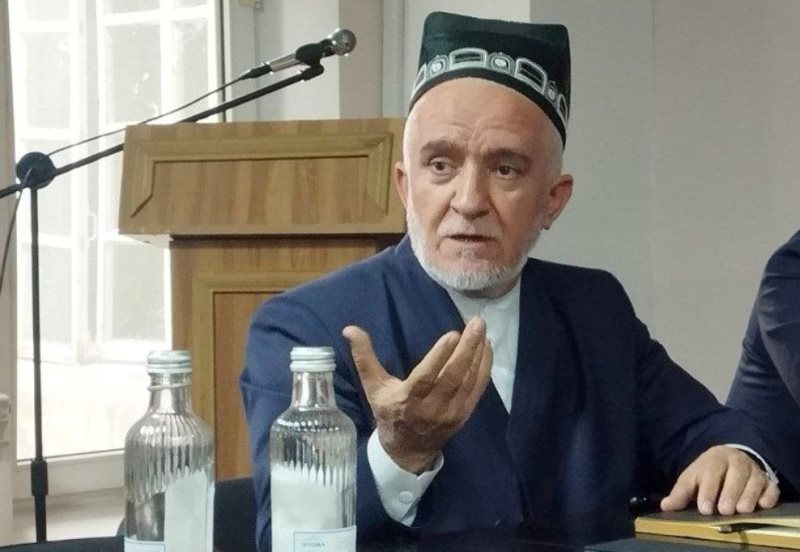
In a pointed statement during a news conference in Dushanbe, Saidmukarram Abduqodirzoda, Chairman of the Council of Ulema of Tajikistan, emphasized on July 29 that Hajj, the sacred Islamic pilgrimage, should not be viewed as a moral or educational institution. He clarified that multiple performances of Umrah do not exempt a Muslim from the religious obligation of performing Hajj.
According to the mufti, the term “Hajji” – commonly used in Tajikistan as a respectful form of address – became widespread due to local customs at the Holy Mosque. “The organizers in the Haram do not know individual pilgrims’ names and address everyone as ‘Hajji’ out of courtesy. Tajik pilgrims often adopt this title upon returning home,” he explained.
Abduqodirzoda suggested that using a person’s real name with respectful titles like “Brother Ahmad” or “Brother Mahmoud” is a more appropriate expression of respect than defaulting to “Hajji.”
Worship is a private matter between the individual and God
The Mufti underscored that all acts of worship are deeply personal and should be performed solely for the sake of Allah. “Whether someone goes for Hajj or Umrah, this is a matter strictly between the individual and their Creator. It has no bearing on their interactions with others,” he said.
Pilgrimage does not guarantee righteousness or knowledge
Abduqodirzoda warned against the assumption that performing Hajj automatically transforms someone into a morally upright or religiously knowledgeable individual. “Hajj is not a university or a center for moral training. Completing the pilgrimage does not guarantee that a person will fear Allah, avoid deceit, or become more learned in Islam,” he said.
He pointed out that some pilgrims return home having failed to properly observe Hajj rituals, and their behavior may remain unchanged. “This is a sign that their Hajj may not have been accepted. One should not assume a person is trustworthy just because they have completed the pilgrimage,” he added. Abduqodirzoda expressed concern that Tajik society sometimes places blind trust in individuals solely because they are “Hajjis,” a tendency he said reflects a lack of religious understanding.
Umrah does not replace the obligation of Hajj
The Mufti also addressed a growing misconception among Tajik pilgrims: that performing Umrah multiple times can substitute for the obligatory Hajj. “A Muslim can perform Umrah as often as they wish, and it counts as a Sunnah. However, it does not lift the obligation of performing Hajj, which remains a Fard (religious duty),” Abduqodirzoda clarified.
Hajj is one of the Five Pillars of Islam and becomes mandatory for Muslims once in their lifetime, provided certain conditions are met. These include being a Muslim, of sound mind, an adult, and financially and physically capable. For women, traveling with a mahram (a male guardian) is also required.
The concept of istita’ah—having the means and ability—is central to the obligation. This includes affording travel costs, being able to support one's family during the absence, and being physically fit to perform the demanding rites of Hajj. If these conditions are not met, the obligation does not apply.
Tajik participation in Hajj and Umrah
According to the Committee on Religious Affairs (CRA), around 5,000 Tajik citizens participated in Hajj this year. Saudi Arabia had allocated 7,000 pilgrimage slots for Tajikistan.
In the first half of 2025, 1,029 people traveled to perform Umrah through the Tajik company “Munzal,” while another 1,124 pilgrims went via “Ormon.” However, authorities acknowledged that they lack comprehensive data on all Tajik Umrah pilgrims, as many travel through third countries like Uzbekistan and Russia.
Globally, Hajj participation has seen a massive surge in recent decades. Over the past 20 years, nearly 40 million Muslims have made the pilgrimage to fulfill this sacred pillar. In 2023, the number of pilgrims to Saudi Arabia reached a historic high.
 Руcский
