




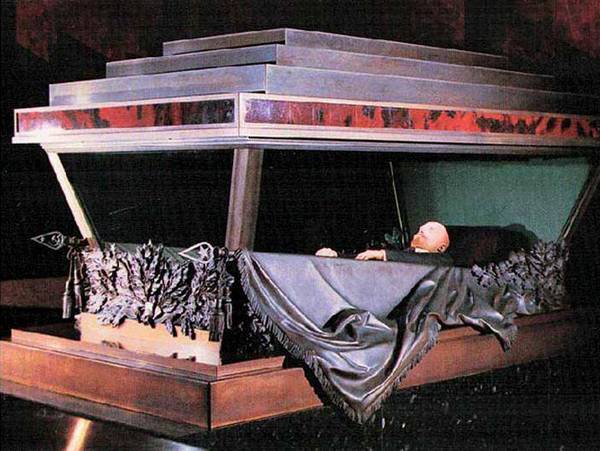
Russia's government has announced it will spend 13.081 million rubles (equivalent to 200,000 U.S. dollars) this year on preserving Vladimir Lenin's embalmed body.
The amount will be used to keep the late leader's remains in what the RBK news website calls a "lifelike condition". The work required is of a "biomedical nature", that the federal budget will foot the bill, and that a provider has already been found, although not named.
A laboratory currently called the Russian Biomedical Technology Research and Training Center has carried out all repairs to Lenin's body since it was first put on public display in Moscow's Red Square in 1924.
In the post-Soviet years there have been many calls for Lenin to be buried rather than kept on public display in his glass coffin. A recent online poll of more than 8,000 Russians found that 62% were in favor of giving him a proper burial, although the idea has previously been dismissed by the Kremlin.
Lenin's Mausoleum, also known as Lenin's Tomb, situated in Red Square in the center of Moscow, is a mausoleum that currently serves as the resting place of Vladimir Lenin. His preserved body has been on public display there since shortly after his death in 1924, with rare exceptions in wartime. Aleksey Shchusev's diminutive but monumental granite structure incorporates some elements from ancient mausoleums, such as the Step Pyramid and the Tomb of Cyrus the Great.
Lenin died on January 21, 1924. Two days later architect Aleksey Shchusev was charged with building a structure suitable for viewing of the body by mourners. A wooden tomb, in Red Square by the Kremlin wall, was ready January 27, and later that day Lenin's coffin was placed in it. More than 100,000 people visited the tomb in the next six weeks. By August 1924, Shchusev had replaced the tomb with a larger one, and Lenin's body transferred to a sarcophagus designed by architect Konstantin Melnikov.
Pathologist Alexei Abrikosov had embalmed the body shortly after Lenin's death, but by 1929 it was determined that it would be possible to preserve the body for much longer than usual; therefore, the next year a new mausoleum of marble, porphyry, granite, and labradorite (by Alexey Shchusev, I.A. Frantsuz and G.K. Yakovlev) was completed.
In 1973 sculptor Nikolai Tomsky designed a new sarcophagus.
On January 26, 1924, the Head of the Moscow Garrison issued an order to place the Guard of Honor at the mausoleum. Russians call it the “Number One Sentry.” After the events of the Russian constitutional crisis of 1993, the Guard of Honor was disbanded. In 1997 the “Number One Sentry” was restored at the Tomb of the Unknown Soldier in Alexander Garden.


GBAO and Khatlon province complete spring draft target early
Chronicle of the month: March, 2026
Donald Trump states US ready to end war with Iran without a Deal
Kyrgyzstan launches domestic production of national currency
Windy April: weather forecast for Tajikistan
Tajikistan faces continued religious freedom challenges
The Judo Grand Slam in Dushanbe: what to expect
New developments in Isfara: schools, power substation, and coal mine opened
Iran claims drone factory in Tajikistan, but no evidence surfaces
Nuclear raid or breaking the blockade: why Trump wants thousands of Marines and paratroopers off the shores of Iran
All news
Авторизуйтесь, пожалуйста