




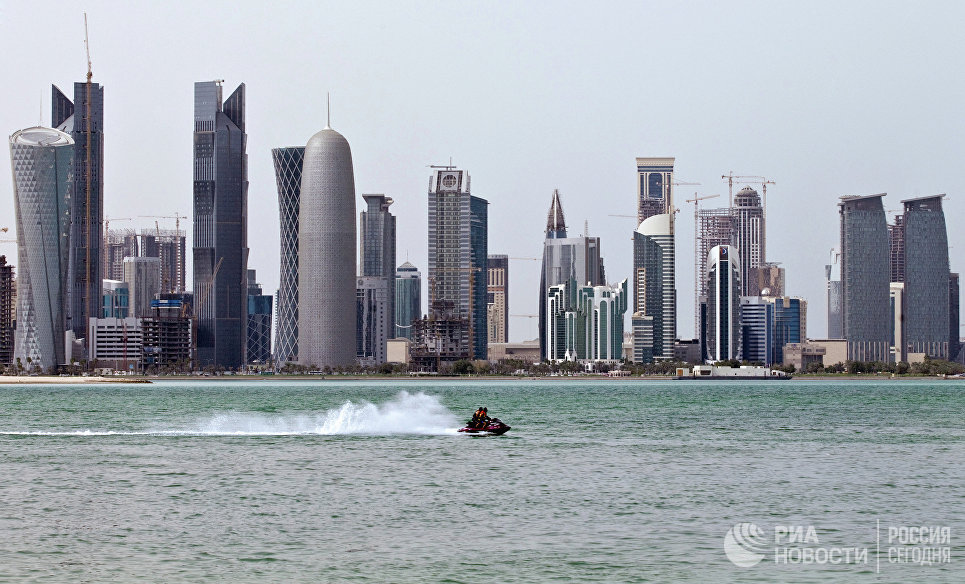
Qatar paid up to $1bn to release members of the Gulf state’s royal family who were kidnapped in Iraq while on a hunting trip, according to people involved in the hostage deal — one of the triggers behind Gulf states’ dramatic decision to cut ties with Doha, the Financial Times (FT) reported on Monday.
Commanders of militant groups and government officials in the region told the Financial Times that Doha spent the money in a transaction that secured the release of 26 members of a Qatari falconry party in southern Iraq and about 50 militants captured by jihadis in Syria. By their telling, Qatar paid off two of the most frequently blacklisted forces of the Middle East in one fell swoop: an al-Qaeda affiliate fighting in Syria and Iranian security officials.
The deal, which was concluded in April, heightened concerns among Qatar’s neighbors about its role in a region plagued by conflict and bitter rivalries. And on Monday, Saudi Arabia, Egypt, the United Arab Emirates and Bahrain took the extraordinary step of cutting off diplomatic ties and transport links to Qatar, alleging the country fuels extremism and terrorism.
“The ransom payments are the straw that broke the camel’s back,” said one Gulf observer.
Doha denies it backs terrorist groups and dismissed the blockade by its neighbors as “founded on allegations that have no basis in fact.” It said it could not immediately respond to a request for comment on the hostage deal. But a person close to the Qatari government acknowledged that “payments” were made. The person was unaware of the amounts or where the money went.
The FT spoke to people involved on both sides of the hostage swap deal, including two government officials in the region, three Iraqi Shia militia leaders and two Syrian opposition figures.
Around $700m was reportedly paid both to Iranian figures and the regional Shia militias they support, according to regional government officials. They added that $200m to $300m went to Islamist groups in Syria, most of that to Tahrir al-Sham, a group with links to al-Qaeda.
Those who spoke to the FT reportedly said the deal highlighted how Qatar has allegedly used hostage payments to bankroll jihadis in Syria. But to its Gulf neighbors, the biggest issue is likely to be the fact that Doha could have paid off their main regional rival, Iran.
This particular saga reportedly began when an Iranian-backed Iraqi Shia militia, known as Kata’eb Hizbollah, kidnapped the Qataris in December 2015. Three Iraqi militia leaders say the hostages were held in Iran.
Kata’eb Hizbollah is an Iraqi group but it is seen as having links with Iran’s main regional proxy, Hizbollah, the Lebanese militant group, which is helping Bashar al-Assad, the Syrian president, according to the FT.
Two regional diplomats reportedly said they believed one of the Iraqi group’s motives for the kidnapping was to give Hizbollah and Iran leverage to negotiate the release of Shia fighters kidnapped by the radical Sunni group Tahrir al-Sham in Syria.
Tahrir al-Sham, in previous iterations, was an al-Qaeda branch. It claims it has broken the connection, but the international community still views it as an affiliate.
Citing Syrian rebels and diplomats, the FT says the hostage transaction was also linked to a separate agreement to facilitate the evacuation of four towns in Syria, two surrounded by jihadi forces and two besieged by Shia militias.


GBAO and Khatlon province complete spring draft target early
Chronicle of the month: March, 2026
Donald Trump states US ready to end war with Iran without a Deal
Kyrgyzstan launches domestic production of national currency
Windy April: weather forecast for Tajikistan
Tajikistan faces continued religious freedom challenges
The Judo Grand Slam in Dushanbe: what to expect
New developments in Isfara: schools, power substation, and coal mine opened
Iran claims drone factory in Tajikistan, but no evidence surfaces
Nuclear raid or breaking the blockade: why Trump wants thousands of Marines and paratroopers off the shores of Iran
All news
Авторизуйтесь, пожалуйста