




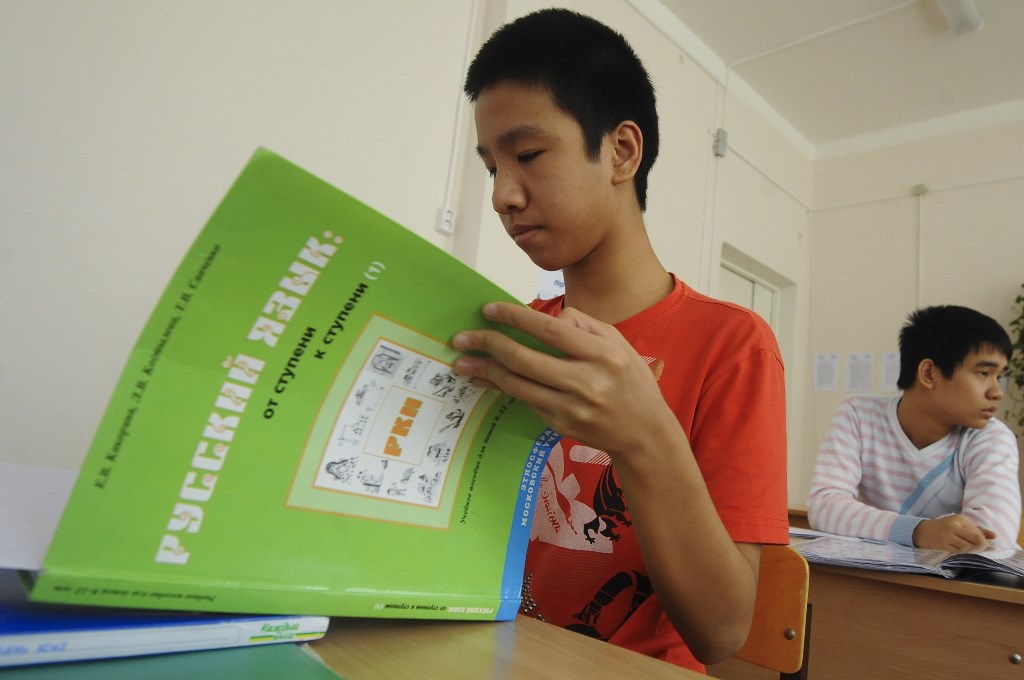
The Russian government plans to introduce specialized Russian language textbook tailored for children of migrant families. The initiative was discussed during a roundtable hosted by the Federation Council’s Committee on Science, Education, and Culture, Parlamentskaya Gazeta says.
The Committee head Lilia Gumerova reportedly supported the proposal and emphasized the importance of creating and distributing such materials nationwide.
"This should be seen not as an expense, but as an investment in quality education," Gumerova said. "We are looking forward to the release of textbooks for migrant children."
The discussion centered on the challenges faced by the children of labor migrants in Russian schools. Educators from various regions reported that in some classrooms, up to half of the students struggle with the Russian language, which severely hinders their ability to grasp the curriculum.
One major issue raised was the lack of teaching materials designed for Russian as a foreign language, which leaves teachers without proper tools to support these students. Larisa Zver’kova, head of the Association of School Principals in Tver, stressed that the absence of suitable textbooks exacerbates the problem.
Many migrant children have been unable to pass the mandatory Russian language test required for school admission. Officials cited a lack of documentation—often due to parents’ limited Russian proficiency—as a key reason. According to the Ministry of Education, among those who were allowed to take the test, only two-thirds passed successfully.
However, the government has introduced support measures for children who fail the test, including free preparatory language courses. Teachers working with foreign children are also required to undergo special training to enhance their qualifications.
Experts highlighted a broader issue: a shortage of qualified Russian language instructors and a widening generational gap between experienced educators and young specialists in Russian philology across CIS countries. Sergey Barchenko, director of the Herzen Pedagogical University branch in Tashkent, noted that while older generations in Uzbekistan's major cities still possess a basic knowledge of Russian, language proficiency declines significantly in rural areas.
Sergey Volkov, acting rector of the Kyrgyz-Russian Slavic University, reported that only 274 out of nearly 2,400 schools in Kyrgyzstan offer Russian-language instruction, despite Russian being an official language in the country. These schools are often overcrowded, and half of their teachers are at or near retirement age.
As of April 1, 2025, Russia introduced mandatory Russian language testing for foreign children enrolling in school. The Ministry of Education received 1,762 applications in April, but only 335 families managed to submit all required documents. Of those tested, just 60–70% of the children passed, according to Deputy Education Minister Olga Koludarova.
"We are not abandoning these children," Koludarova emphasized. "We are offering three-month courses either within schools or through supplementary education programs. A list of participating institutions will be published soon."
Additionally, the Ministry of Education plans to launch a new teacher training program this summer for educators working with migrant children.
According to the Pushkin Institute of the Russian Language, Russian is spoken by approximately 255 million people worldwide, making it the ninth most widely spoken language globally.
 Руcский
