




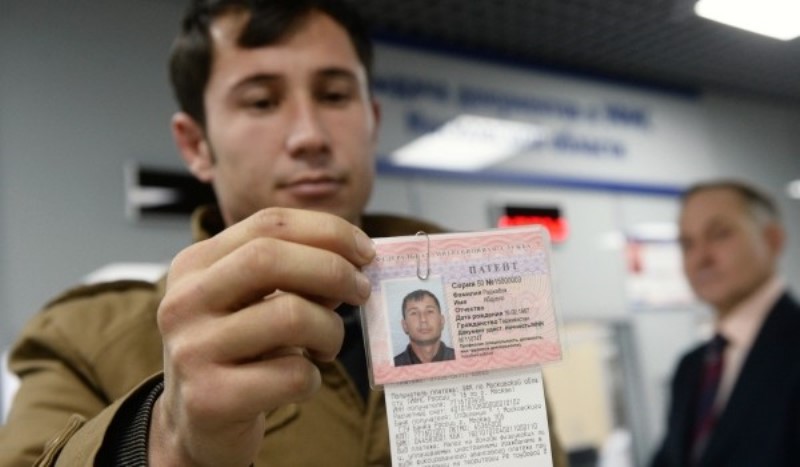
The Moscow City Duma has approved an increase in the cost of work patents for foreign nationals, raising the monthly fee from 8,900 to 10,000 rubles starting next year. The decision was made during a plenary session and is based on an annual adjustment of the regional coefficient, according to Interfax.
Darya Murchenko, Deputy Head of the Department of Economic Policy and Development and Chief of the Tax Analysis Office, explained that the regional coefficient is reviewed annually to reflect changes in the city’s average wage.
“This year, we propose setting the coefficient at 2.9323, which will raise the monthly patent fee to 10,000 rubles,” she said. “This adjustment aims to bring the tax burden on migrants closer to that of Russian citizens.”
Murchenko noted that the cost of a patent for migrants is calculated by multiplying three components: a base rate set by the Tax Code, a federal deflator coefficient determined annually by the Ministry of Economic Development, and a regional coefficient established by local authorities.
Authorities also factor in the average salaries in sectors where migrant labor is most common, as well as the administrative costs of processing patents at the state-run Migration Center. Starting January 1, 2025, a new government fee for obtaining patents will also be introduced.
“We assess all these elements together to determine a fair rate. Our new fee aligns with the current rate in the Moscow region, which we believe ensures a balanced approach,” Murchenko added.
Other regions to raise patent fees in 2026
Similar increases are expected from January 1, 2026, in several other Russian regions, including Tyumen, Kamchatka, Irkutsk, Leningrad Oblast, Novosibirsk, and Krasnodar, as well as in Sverdlovsk, and Primorsky Krai,
In Tyumen Oblast, the price of a patent will rise by 22%, reaching 11,471 rubles in 2026, up from 9,385 rubles in 2025.
In the Kamchatka Krai, the fee will jump from 9,000 to 13,800 rubles following a regional legislative decision to raise the coefficient from 2.9 to 4.1.
Irkutsk Oblast has set the monthly payment for 2026 at 12,000 rubles, up from 11,000 rubles.
In both Saint Petersburg and Leningrad Oblast, the cost of work permits will rise from 6,000 to 8,000 rubles following a joint decision by regional authorities.
In Novosibirsk, the cost will increase by 11%, reaching 10,860 rubles—a rise of 954 rubles compared to the previous year. Officials project this change will generate an additional 2.5 billion rubles in budget revenue.
In Krasnodar, the cost of a work patent will surge by approximately 59%, reaching 27,000 rubles starting in 2026.
Sverdlovsk Oblast is also increasing the monthly fee for foreign workers, from 7,500 to 9,500 rubles. Regional officials estimate this change will add around 4 billion rubles in additional revenue to the local budget.
In Primorsky Krai, the regional parliament has approved a rise in the patent fee to 13,800 rubles, effective from 2026.
The cost of work patents for migrants is adjusted annually in most Russian regions, with increases being the norm. The amount varies depending on the region and local economic policies. Regional authorities say the increase in fees for foreign workers will contribute substantial additional revenue to local budgets.
A work patent allows foreign nationals to be legally employed within a specific region and industry in Russia. However, obtaining one involves submitting a comprehensive set of documents, typically costing migrants around 30,000 rubles.
Failure to pay the monthly patent fee can lead to the revocation of the migrant’s right to stay in Russia and potential deportation.
 Руcский
