




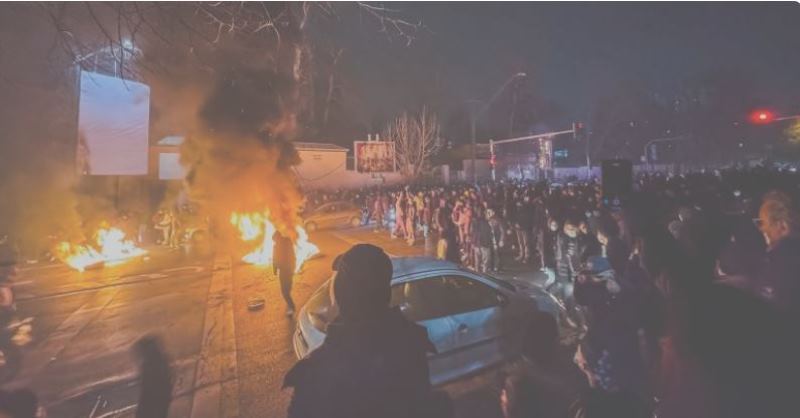
Ongoing anti-government protests in Iran are widely regarded as the most serious challenge to the Islamic Republic in recent years, according to international media and human rights groups.
The Guardian, citing the Norway-based NGO Iran Human Rights, reports that at least 648 protesters have been killed in a nationwide crackdown. Thousands more have reportedly been injured since demonstrations erupted on December 28, triggered by the collapse of Iran’s currency, the rial, and worsening economic conditions.
Speaking during a diplomatic visit to India on January 13, German Chancellor Friedrich Merz reportedly said he believes the Iranian government may be in its “final days and weeks,” arguing that the regime lacks “legitimacy through elections in the population.”
“If a regime can only keep itself in power by force, then it’s effectively at the end,” Merz said, according to The Guardian.
The Associated Press reported on Tuesday that Iranian mobile phone users were again able to make international calls, although restrictions on internet access remain in place.
The protests, which began in Tehran on December 28 before spreading nationwide, have evolved into broader demonstrations against Iran’s political leadership, with protesters voicing anger over economic hardship as well as social and political restrictions. The rial has continued to depreciate sharply, while the government’s decision to end a subsidized exchange rate for importers has led to a surge in food prices, The Guardian reported.
Iran’s economic crisis has been exacerbated by international sanctions. In September last year, wide-ranging United Nations sanctions were reimposed for the first time in a decade after the United Kingdom, France, and Germany triggered the measures, citing Tehran’s failure to address concerns over its nuclear program. Iran was already under significant strain from U.S. sanctions that cut the country off from much of the global financial system.
Sanctions imposed by the United States, the European Union, the United Nations, and other actors have contributed to high inflation, soaring consumer prices, and a sharp devaluation of the rial, worsening living conditions for ordinary Iranians.
At the same time, pro-government rallies have been held in several cities. State media reported that a large demonstration took place in Tehran, attended by thousands of people, including President Masoud Pezeshkian.
According to Al Jazeera, Iranian Foreign Minister Abbas Araghchi accused foreign actors of fueling the unrest, claiming the protests had “turned violent and bloody to give an excuse” for U.S. President Donald Trump to intervene militarily.
Araghchi told foreign diplomats in Tehran that violence spiked over the weekend but insisted that the “situation is now under total control.” He alleged that Trump’s warnings of military action had encouraged “terrorists” to target protesters and security forces in an attempt to provoke foreign intervention.
“We are ready for war but also for dialogue,” Araghchi was quoted as saying. He also claimed authorities possess footage showing weapons being distributed to protesters and said confessions from detainees would soon be released. The demonstrations, he added, were “stoked and fueled” by foreign elements, warning that security forces would “hunt down” those responsible.
Trump threatens tariffs on countries trading with Iran
Meanwhile, U.S. President Donald Trump said on January 12 that any country conducting business with Iran would face a 25% tariff on trade with the United States, according to Reuters.
“Effective immediately, any Country doing business with the Islamic Republic of Iran will pay a Tariff of 25% on any and all business being done with the United States of America,” Trump said in a post on Truth Social, adding that the order was “final and conclusive.”
Reuters reported that no official documentation of the policy had appeared on the White House website, and it remains unclear what legal authority would be used to impose the tariffs or whether they would apply to all of Iran’s trading partners. The White House did not respond to requests for comment.
Iran has been under heavy U.S. sanctions for years and reportedly exports most of its oil to China. Other major trading partners include Türkiye, Iraq, the United Arab Emirates, and India.


GBAO and Khatlon province complete spring draft target early
Chronicle of the month: March, 2026
Donald Trump states US ready to end war with Iran without a Deal
Kyrgyzstan launches domestic production of national currency
Windy April: weather forecast for Tajikistan
Tajikistan faces continued religious freedom challenges
The Judo Grand Slam in Dushanbe: what to expect
New developments in Isfara: schools, power substation, and coal mine opened
Iran claims drone factory in Tajikistan, but no evidence surfaces
Nuclear raid or breaking the blockade: why Trump wants thousands of Marines and paratroopers off the shores of Iran
All news
Авторизуйтесь, пожалуйста