




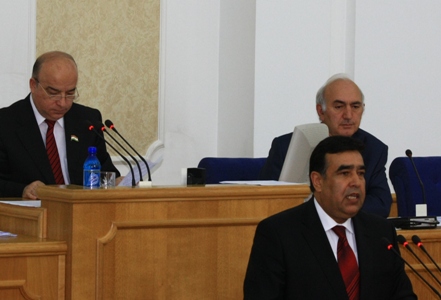
DUSHANBE, June 15, 2011, Asia-Plus - Tajik Education Minister Abdujabbor Rahmonov said that Tajik Ministry of Education received more than 4000 messages with various suggestions and additions to the draft law.
“The results of public discussion show that major portion of the population supports the law,” top education official has said.
He said a series of amendments and changes were introduced into the law regarding attendance of mosques by children and teenagers.
“The law allows children and teenagers who study at religious schools to attend mosques and be members of religious associations, however, children who study at secular schools are not allowed to attend mosques until they reach 18 years of age,” Rahmonov stressed.
He also said that the law does not forbid children to attend mosques during religious holidays.
Leader of the Islamic Renaissance Party of Tajikistan, deputy Moukhiddin Kabiri, said that he would vote for the law in case if the new ban will create conditions for appearance of new academicians, scholars and scientists. “With the correct use of the potential of mosques by the state, mosques could provide valuable support to secular schools,” IRPT leader said.
His colleague from IRPT, deputy Umarali Huseinov, said that the draft law violates the rights of believers and asked deputies not to vote for it.
“The draft law is another attempt of the state to hand over responsibilities of the most corrupt ministry of the country – Ministry of Education – to society,” he said.
In response Tajik Education Minister said that it is immoral to call more than 150.000 teachers corrupt.
Deputy of the Communist party Ismoil Talbakov urged his colleagues to vote “for” the draft law and said that opponents should not forget about the fact that Tajikistan is a secular state.
Deputy of the ruling People’s and Democratic party Davlatali Davlatzoda said that in the conditions of changing world it is strange that some politicians are still arguing what Tajik women should wear and whether it is reasonable or not to allow people attend mosques.
“We cannot entrust our future to mullahs, major part of whom have neither secular nor religious education,” he said.
Additionally, Davlatzoda said that if we continue to think about religious education only, Tajikistan may finally turn into the country that produces guest workers.
“I’m ashamed of the fact that foreigners build the majority of roads in our country. But this happens because we do not have professional constructors,” Davlatzoda said.
The draft law “On parental responsibility for education and upbringing of children” was proposed by the President on December 14th, 2010. He also initiated the development of similar draft law. He proposed to do that during his meeting with education officials and scientists. The meeting was dedicated to the Year of Education and Technical Culture on December 23, 2009.
The document was considered by the Government on December 29 last year and was returned for further improvement. Head of state ordered to clarify legal standards, responsibilities and duties of parents and other responsible persons for upbringing children and clarify implementation mechanism.


GBAO and Khatlon province complete spring draft target early
Chronicle of the month: March, 2026
Donald Trump states US ready to end war with Iran without a Deal
Kyrgyzstan launches domestic production of national currency
Windy April: weather forecast for Tajikistan
Tajikistan faces continued religious freedom challenges
The Judo Grand Slam in Dushanbe: what to expect
New developments in Isfara: schools, power substation, and coal mine opened
Iran claims drone factory in Tajikistan, but no evidence surfaces
Nuclear raid or breaking the blockade: why Trump wants thousands of Marines and paratroopers off the shores of Iran
All news
Авторизуйтесь, пожалуйста
ghassan29 июн, 2011 12:34
This government is obviously desperate and on its last legs. It will soon be assigned to the dust bin of history.