




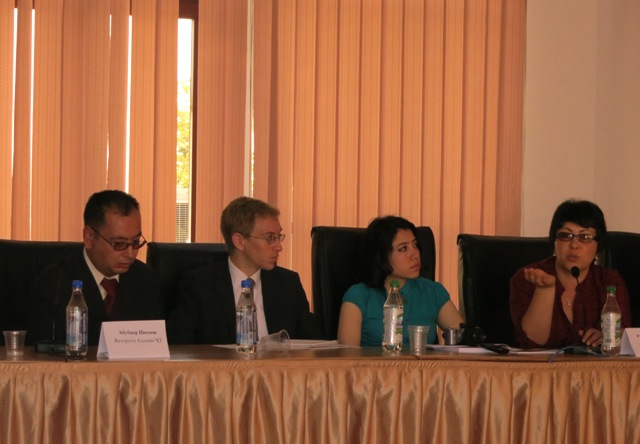
DUSHANBE, April 30, 2014, Asia-Plus – The Center for Child’s Rights made presentation of a draft law on mediation on April 30.
The law has been drafted by specialists from the Ministry of Justice, President’s Executive Office and deputies of the Majlisi Namoyandagon (Tajikistan’s lower chamber of parliament).
Speaking at the meeting, one of authors of the draft law, Abubakr Inomov, noted that mediation was a form of alternative dispute resolution. “It is a judge who considers a minor’s case independently of judicial bodies. If disputants reach an agreement, the mediator passes a resolution on abatement of action and this resolution moves to a court,” Inomov said.
According to him, mediator is an organization that must work independently, without financial support from the government. “The mediation institution has been planned as an independent body but it is impossible to create anything from scratch,” said Inomov. “Therefore, we together with international organizations have made a decision that a separate body will be established two years after the law is passed.”
Mediation, as used in law, is a form of alternative dispute resolution (ADR), a way of resolving disputes between two or more parties with concrete effects. Typically, a third party, the mediator, assists the parties to negotiate a settlement. Disputants may mediate disputes in a variety of domains, such as commercial, legal, diplomatic, workplace, community and family matters.
The term "mediation" broadly refers to any instance in which a third party helps others reach agreement. More specifically, mediation has a structure, timetable and dynamics that "ordinary" negotiation lacks. The process is private and confidential, possibly enforced by law. Participation is typically voluntary. The mediator acts as a neutral third party and facilitates rather than directs the process.
Mediators use various techniques to open, or improve, dialogue and empathy between disputants, aiming to help the parties reach an agreement.


GBAO and Khatlon province complete spring draft target early
Chronicle of the month: March, 2026
Donald Trump states US ready to end war with Iran without a Deal
Kyrgyzstan launches domestic production of national currency
Windy April: weather forecast for Tajikistan
Tajikistan faces continued religious freedom challenges
The Judo Grand Slam in Dushanbe: what to expect
New developments in Isfara: schools, power substation, and coal mine opened
Iran claims drone factory in Tajikistan, but no evidence surfaces
Nuclear raid or breaking the blockade: why Trump wants thousands of Marines and paratroopers off the shores of Iran
All news