





A new highway connecting Obigarm and Nourobod is opening a path not just through the mountains, but toward greater regional connectivity and development. Officially inaugurated on August 26, 2025, by President Emomali Rahmon, the road links Dushanbe with the country’s northeastern districts and extends toward the Kyrgyz border.
Supported by the Asian Development Bank (ADB) and the OPEC Fund for International Development, the highway is already changing lives. More than 20 villages now have faster and safer access to jobs, schools, and hospitals.
A road carved into rock
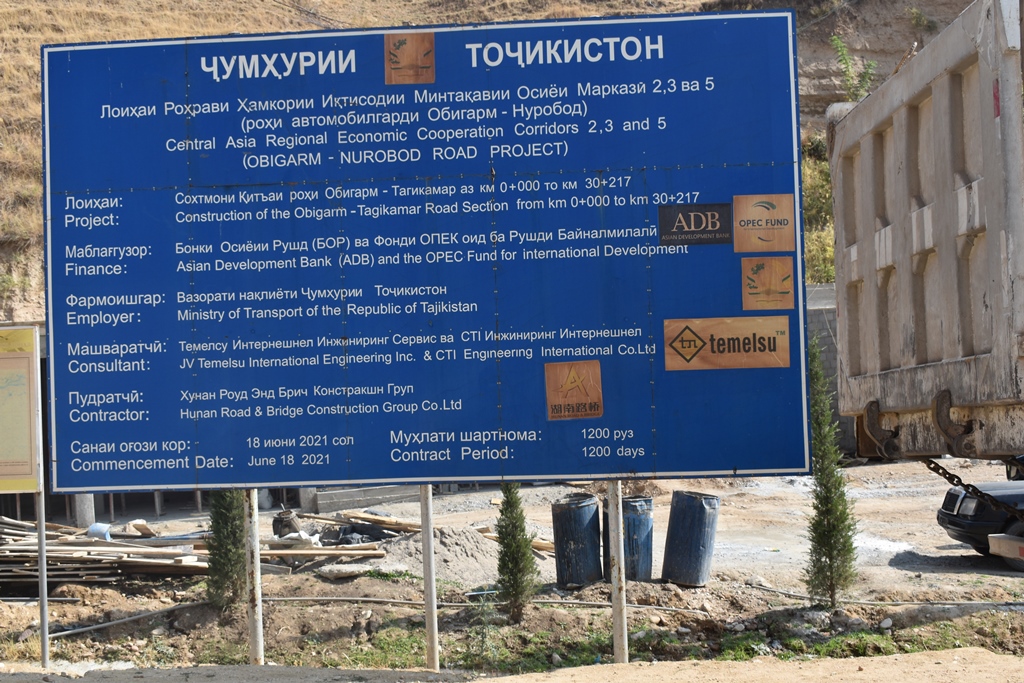
At the route’s starting point stands a large project information board — the numbers behind it representing years of hard labor. The newly completed 30.1 km stretch winds through some of Tajikistan’s most rugged terrain. Along the route are six bridges, two tunnels, 76 culverts, over 112,000 cubic meters of retaining walls, and 184,000 cubic meters of gabion structures — wire mesh cages filled with rock to stabilize slopes.
Construction began on June 18, 2021, and was completed in September 2025.
Project manager Shohnazir Jobirov from the Ministry of Transport’s Project Implementation Center explained that at the project’s peak, nearly 200 modern machines were operating simultaneously.
“Eighty-seven percent of our workforce came from local communities,” Jobirov noted. “For many, this road was more than just infrastructure — it was a vital source of income for their families.”
From blueprint to mountain pass
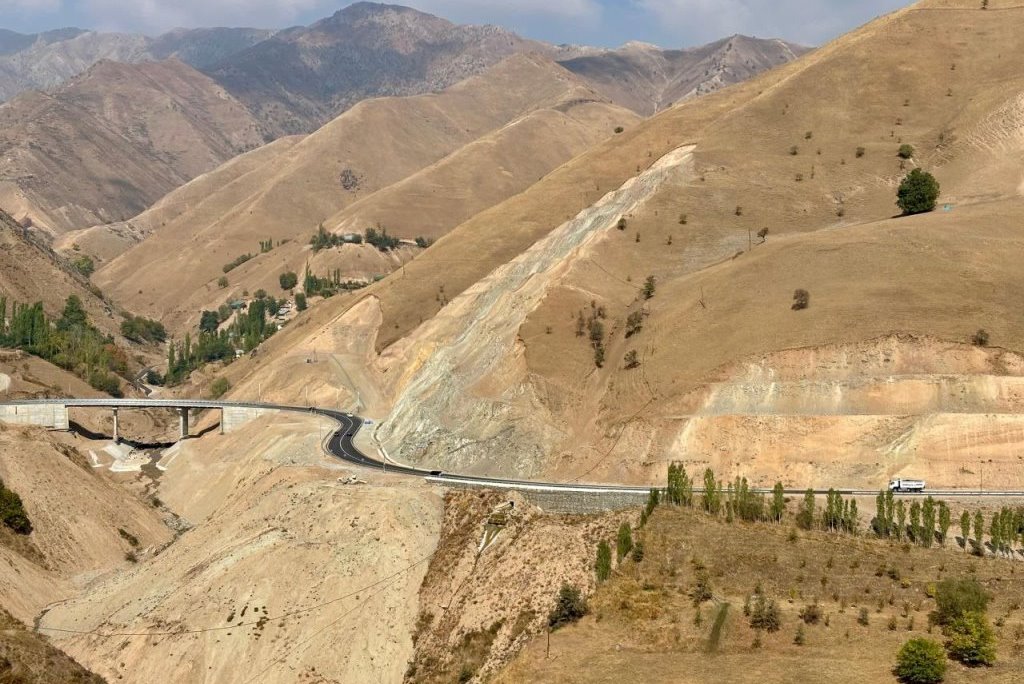
The most challenging stretch — from Obigarm to Tagikamar — is now a smooth, stable road replacing what was once a dangerous mountain trail. As part of regional CAREC Corridors 2, 3, and 5, the project is co-financed by the ADB and OPEC Fund.
Modern engineering techniques were used throughout: the road surface includes three layers of asphalt totaling 15 cm, with a carriageway width of 8 to 12 meters. Additional climbing lanes have been added on steep inclines.
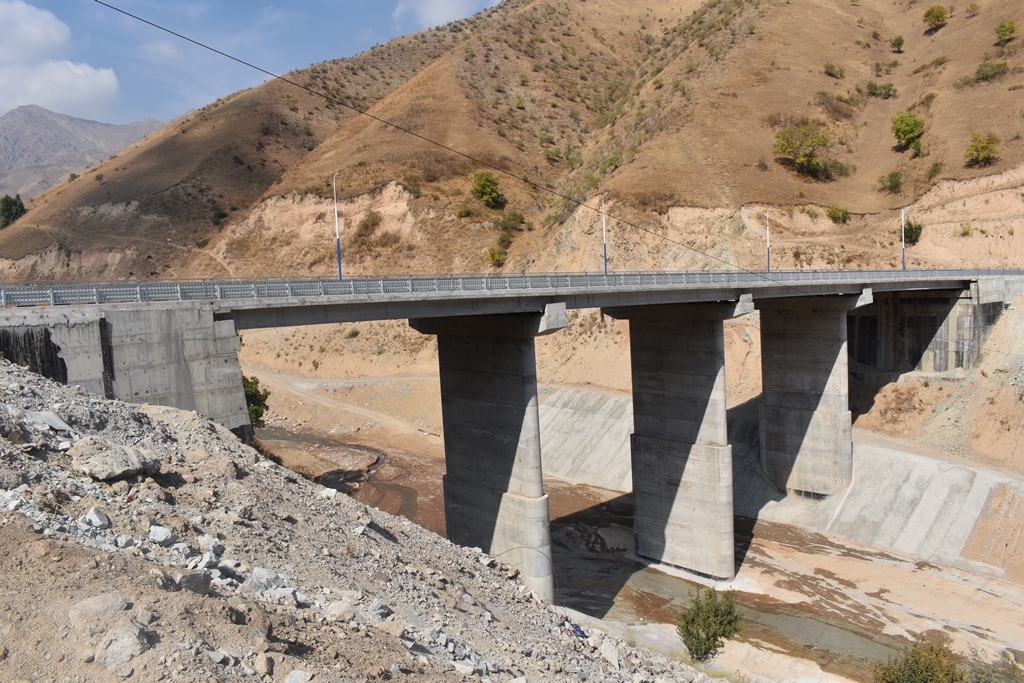
The scale is impressive: over 1.8 million cubic meters of soil and nearly 2 million cubic meters of rock were excavated. Drainage ditches and side channels run along the road to prevent erosion, while reflective road signs and new markers improve safety on sharp curves.
A road built to endure
Between steep mountain slopes now lies a durable three-layer asphalt highway, designed to withstand heat, frost, and heavy truckloads. Over 42 kilometers of drainage infrastructure was laid to manage rainwater and protect the road surface.
Slopes were reinforced using reinforced concrete walls and gabions, securing the ground against erosion and landslides.
“Every meter of this road came at a cost,” recalls project manager Shohnazir Jobirov. “We reinforced the slopes with concrete and gabions to ensure the road withstands both time and nature. The important thing is — we succeeded.”
A green ribbon through the mountains
Beyond concrete and asphalt, the new road has introduced a green belt in the highlands. Along its edges, 16,000 pine trees and hawthorn shrubs were planted to stabilize soil and prevent erosion. Additionally, 22 nearby villages benefited from improved access roads — another 30 kilometers — making it easier for residents to reach the main highway.
The project also had a social component. Twelve women from neighboring villages received training and grants of up to $2,000 to start small businesses — from tailoring to baking and growing herbs. The road is not only reshaping the landscape but also revitalizing local economies.
From shepherd trails to smart tunnels
Where once only shepherds walked, now stand modern tunnel portals — including the “Oryono” Tunnel (formerly Kandak). It features advanced safety systems: digital displays, ventilation, lighting, emergency exits, and control buildings with 500 kW backup generators to keep operations running during power outages.
Construction was grueling — in some areas, progress slowed to half a meter per day due to the hardness of the rock. Still, the team kept pace with two work shifts and up to 1,800 workers, most from nearby villages.
The Oryono Tunnel spans 1.6 km and is a critical part of this strategic transport corridor. A second tunnel, “Vahdat” (formerly Karagoch), is 1.7 km long and mirrors Oryono in its construction and safety features.
Inside Oryono: 12 systems in harmony
Step inside and the experience shifts — even lighting, clean air, sensors, and cameras work together. Twelve engineering systems operate across the tunnel’s 1.6 km, from firefighting and communications to emergency exits. Each end is equipped with 500 kW generators with automatic activation.
“Every component — from cabling to fans — passed rigorous testing,” engineers noted. “We built it for longevity and maximum safety.”
With anti-glare lighting, electronic signage, and automated fire response, drivers can travel confidently, even in harsh mountain conditions.
The Obigarm–Nourobod highway is more than a road. It’s a lifeline connecting regions, a source of jobs, a greener mountain corridor, and a testament to Tajikistan’s ability to build resilient infrastructure in one of the world’s toughest terrains. As more sections open, travel across northeastern Tajikistan will become faster, safer, and more efficient — bringing long-term benefits to communities across the region.
 Руcский
