




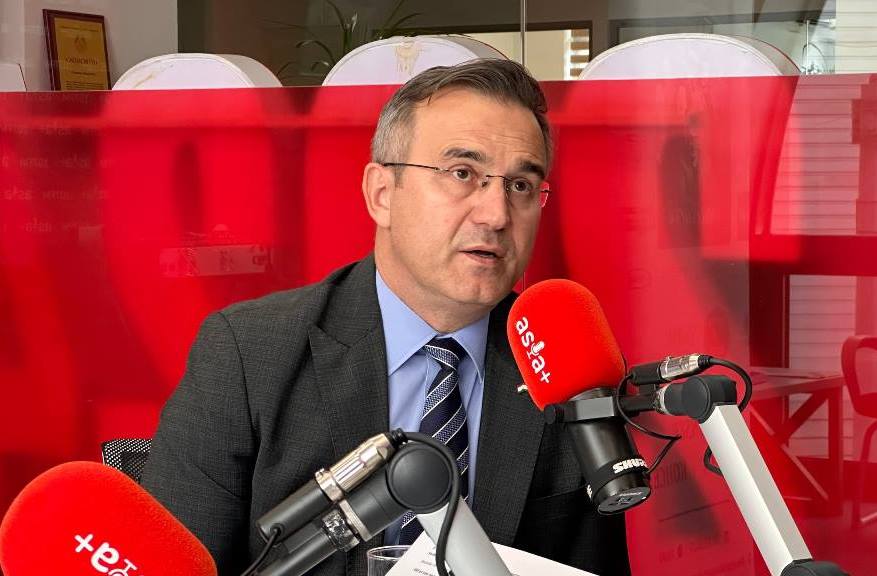
Turkish Ambassador to Tajikistan, Umut Acar, was a guest on the Asia-Plus radio station, where he discussed the development of Tajik-Turkish relations, cultural diplomacy, and a topic that concerns many Tajik citizens — the potential simplification of the visa regime between Turkey and Tajikistan.
The occasion for the interview was Turkiye's Republic Day, celebrated on October 29, which symbolizes renewal, independence, and national unity for the Turkish people. As Acar noted, this year marks the 102nd anniversary of the Republic’s founding.
A state where men and women are equal
“This date is more than just a celebration for us; it's a symbol of our national identity. Like the Tajik people, the Turkish nation has a history stretching back 5,000 years. Our republic is the successor of the Ottoman Empire. In 1923, we founded the Republic of Turkiye for the first time.
It is a secular and modern state where religion and state are separate, men and women have equal rights, and all are equal before the law.
In 1923, the population of Turkiye was 13 million. Today, it stands at 76 million. Our economy is worth $3.5 trillion, and we rank 11th in the world by purchasing power. Of course, we are proud of these achievements.
We honor the memory of the founder of our republic and our first president, Mustafa Kemal Atatürk.
On October 29, we will host an official reception marking the founding of the Republic of Turkiye at Kokhi Navrouz, and we look forward to welcoming our Tajik friends and guests.”
Q. We heard there will be a concert in Dushanbe featuring Turkish artists — who will perform, and when and where will it take place?
A. “The concert will be held on Tuesday, October 28 at 6:30 p.m. at the Akasharif Juraev State Philharmonic in Dushanbe. Admission is free.
I’m especially excited because one of my favorite musical groups — Yeni Türkü (New Song) — is coming to Tajikistan. My generation grew up with their music, so their songs are very special to us. They combine traditional Turkish instruments with Western styles. I'm confident that audiences in Dushanbe will fall in love with them too.”
On Tajikistan–Turkey Relations
Q. In which areas is Tajik-Turkish cooperation currently most active?
A. “Tajikistan and Turkiye are friendly nations. We don’t have any serious issues, and when we meet, we only discuss positive developments.
Our trade relations grow stronger every year. Last year, our bilateral trade volume reached $620 million, and this year, we expect it to exceed $700 million. Our goal is to raise it to $1 billion.
We always support investors and companies that come to Tajikistan and invest in its sectors — especially agriculture, education, mining, textiles, and energy.
Just recently, on October 27, a new eye clinic opened in Dushanbe. I’m pleased to see increased investments in Tajikistan’s healthcare sector. For example, Turkiye’s largest medical groups, Acibadem and Medicana, have established branches here. There’s also a joint Tajik-Turkish clinic in Dushanbe. These joint investments bring us great satisfaction.
I want to emphasize that the agenda of our relations is always positive. We are citizens of two countries that respect and care for each other.”

Q. In your view, what role does culture play in strengthening the relationship between our countries?
A. “Culture is the area I value most because, unfortunately, I see we aren’t as active in this field as we could be. Culture is the most sincere and genuine bridge between people. Throughout history, the Turkish and Tajik peoples have shared the civilizational heritage of the Great Silk Road.
In Tajikistan, there is strong interest in our annual Turkish Cuisine Week. I’ve long advocated for establishing cultural centers in both countries to deepen our understanding of one another.
For instance, Tajikistan could open a cultural center in Turkiye named after Abuabdullo Roudaki. In Turkiye, we have cultural centers named after our poet Yunus Emre. We are ready to assist our Tajik friends in opening such a center here.
I also want to point out that currently, there are hardly any places in Turkiye where Tajik language is taught or Tajik culture is introduced. Cultural centers in both countries could host literature weeks, film screenings, and invite artists — helping us share our histories with the next generation. I take this opportunity to renew my proposal.”
On Tajik students in Turkiye
Q. Turkey is known for its educational programs for international students. How many Tajik students are currently studying in Turkiye, and how are these exchanges developing?
A. “Every year, we run scholarship programs for many countries, including Tajikistan. Currently, about 1,200 Tajik students are enrolled in Turkish universities, with 400 of them receiving full scholarships.
Over the past 10 years, more than 2,500 Tajik students have graduated from Turkish universities. We allocate around 60–70 scholarships for Tajik students annually. These programs are usually announced in January or February.
In addition, Turkiye is implementing the Maarif school project in Tajikistan. As a father of two children, I’ve observed that there are not enough international schools here — and those that do exist are very expensive.”
Q. The Turkish Embassy organizes Turkish language courses. Are they still active, and how much interest do Tajiks show in them?
A. “It seems not everyone is aware of them, or perhaps we haven’t promoted them well enough. For 30 years, there has been a Turkish Language Learning Center in Tajikistan. Every year, around 900 Tajik citizens study there. The courses are free and open to people of all ages. Registration takes place every August.”

On the visa regime
Q. In recent years, air travel between Turkiye and Tajikistan has grown rapidly. Are there any ongoing discussions about simplifying the visa regime?
A. “Unfortunately, fuel is very expensive in Tajikistan. But it's important to remember that Tajikistan isn’t a country rich in natural gas or oil. So, it’s not realistic to expect lower prices than in other countries.
We are negotiating with Tajik authorities on this. Perhaps tax incentives or discounts could be introduced for aviation fuel. This would encourage more airlines to fly to Tajikistan, making ticket prices more affordable. For example, I paid $1,200 for a round-trip ticket between Turkiye and Tajikistan this summer — a very high price compared to other Central Asian countries.
This is an issue we need to work on together. I’m not complaining, just stating facts.
Regarding visas — discussions with our Tajik counterparts are ongoing. Political consultations between our countries will take place in Ankara next month, and visa facilitation is on the agenda at the highest level. In urgent cases, we issue visas the same day — especially for businesspeople, journalists, or those attending important meetings.
Sometimes we receive unfair complaints suggesting it’s harder to get a Turkish visa than an American or European one — but that’s simply not true.
I want to highlight that the official visa center in Tajikistan is AVS LLC. Unfortunately, I’ve also seen fake visa center pages on social media. Please be cautious and verify who you’re dealing with. AVS provides assistance directly and does not require intermediaries.”
“I don’t feel like a stranger here”
Q. What aspects of Tajik culture and lifestyle resonate most with you?
A. “I feel at home in Tajikistan. This is the fifth country I’ve worked in, but here — it feels like home. Our cultures are very similar — cuisine, customs, everyday habits. I never feel like a foreigner here, and Tajik hospitality plays a big role in that.
The local landscape also reminds me of Turkiye — especially Anatolia.
As the Turkish ambassador in Tajikistan, I feel proud of the progress your country is making across all sectors. When we speak of brotherhood and friendship, it means celebrating each other’s successes — and that is the essence of our relationship.”
 Руcский
