




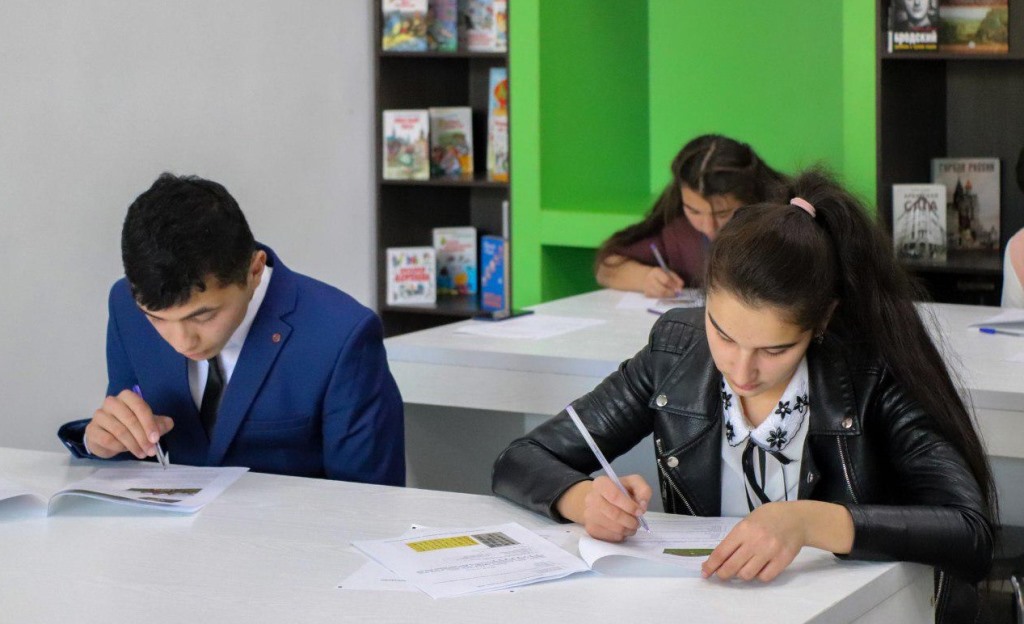
Application campaign for 2025–2026 academic year opens with 1,000 spots reserved for Tajikistan. The admission campaign for Tajik students seeking to study in Russian universities under a government quota officially began on September 15, according to the representative office of Rossotrudnichestvo (The Federal Agency for the Commonwealth of Independent States Affairs, Compatriots Living Abroad, and International Humanitarian Cooperation) in Dushanbe.
Applicants must register on the platform education-in-russia.com, select a university and program, complete the online application form, upload a photo and scanned copies of their passport and education documents, and pass remote entrance exams before receiving placement at a Russian university.
Registration will remain open until December 15, 2025. To assist applicants, in-person consultations will be held every Friday at 4:00 p.m. at the Russian House in Dushanbe (1st passage, 4 Lohouti Street). Questions can also be sent via email to [email protected], or by phone in Dushanbe (+992 37 221-89-47) and Khujand (+992 34 226-02-22).
Russia allocates 1,000 educational quotas annually for Tajikistan — one of the largest shares provided to any foreign country.
Will the number of quotas increase?
Speaking earlier this year on Asia-Plus Radio’s Second Breath program, Rossotrudnichestvo head Yevgeny Primakov said expanding quotas is not the current priority.
“One thousand spots is already a lot. The only country with more is Belarus — 1,300 places — but Belarus and Russia are part of a Union State with a different level of integration. Tajikistan comes second,” he explained. “For every spot in Tajikistan, there are about 3.5 to 4 applicants. That’s good. Our goal is not to raise the number of quotas, but to increase the number of applicants to ensure healthy competition.”
Primakov added that globally, Russia recruits around 30,000 foreign students annually, but in some countries competition is far lower — one or 1.5 applicants per spot — which reduces selectivity. He said Rossotrudnichestvo is investing in preparatory courses and motivational programs, which he considers “more effective than simply expanding quotas.”
As in previous years, Tajik students most often choose medicine, law, and information technology as their preferred fields of study.
 Руcский
