




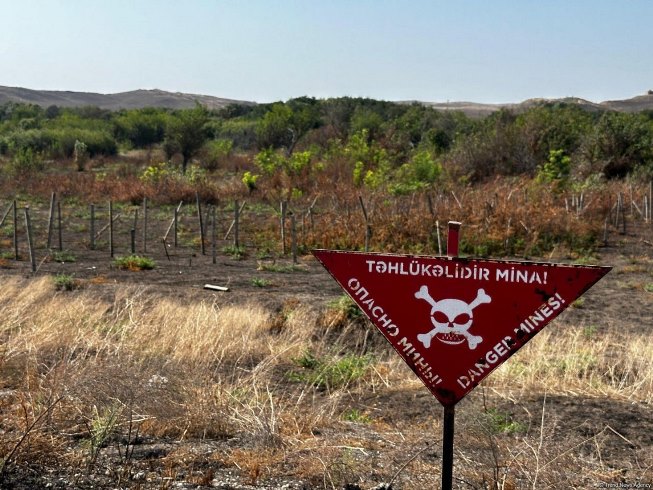
Azerbaijan is calling on the international community to intensify support for global demining efforts, highlighting the deadly and long-lasting threat posed by landmines, explosive remnants of war (ERW), and improvised explosive devices. These hidden dangers continue to claim lives and obstruct recovery in conflict and post-conflict zones worldwide — threatening not only human safety but also environmental and economic sustainability, says press release issued by Azerbaijan’s Embassy in Dushanbe.
As one of the most heavily mine-contaminated countries globally, Azerbaijan faces a formidable challenge stemming from nearly three decades of conflict. Recent surveys reveal that approximately 11,667 square kilometers — or 13.4% of the nation’s total territory — remain contaminated. Over one million landmines and an unknown quantity of ERWs still endanger civilians, hinder reconstruction, and delay the return of internally displaced persons (IDPs).
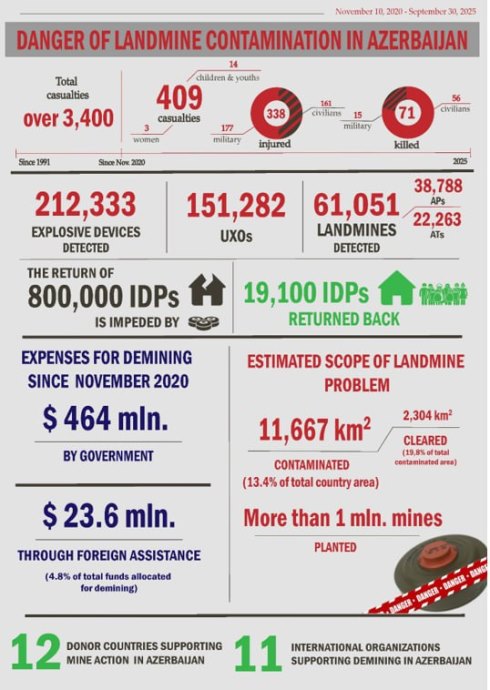
Since the 2020 ceasefire, Azerbaijan has recorded 247 mine-related incidents, resulting in 409 casualties — including women and children. Over the past 30 years, more than 3,400 people have fallen victim to landmines nationwide.
Mine contamination is not only a humanitarian crisis but also a developmental barrier. It poses a direct threat to achieving the United Nations Sustainable Development Goals (SDGs), prompting Azerbaijan to declare humanitarian demining as its 18th National SDG.
Despite the scale of the crisis, international support remains limited. Foreign assistance accounts for just 4.8% of Azerbaijan’s demining resources — a figure far below typical contributions in similar global contexts. The government stresses the need for increased international political and financial support, framing demining as an urgent matter of human solidarity and shared responsibility.
“Demining is essential to restoring safety, supporting reconstruction, and enabling displaced families to return home,” Azerbaijani officials emphasized, calling for coordinated global efforts to meet the scale of the challenge.
Since 2022, Azerbaijan has co-hosted three international mine action conferences with the United Nations, generating actionable outcomes on demining, development, and environmental protection. In a significant diplomatic win, Azerbaijan also secured the adoption of a resolution under the 1954 Hague Convention in 2023 addressing the impact of landmines on cultural heritage sites.
Among the notable advancements in its national program, Azerbaijan launched its first all-female demining teams in partnership with the UN Development Programme (UNDP), the European Union, and the Azerbaijan Mine Action Agency (ANAMA), reflecting growing inclusion and innovation in the sector.
With landmines continuing to kill and maim long after conflicts end, Azerbaijan is urging the global community to step up technical, financial, and political cooperation to address one of the most pressing humanitarian and environmental threats of our time.


GBAO and Khatlon province complete spring draft target early
Chronicle of the month: March, 2026
Donald Trump states US ready to end war with Iran without a Deal
Kyrgyzstan launches domestic production of national currency
Windy April: weather forecast for Tajikistan
Tajikistan faces continued religious freedom challenges
The Judo Grand Slam in Dushanbe: what to expect
New developments in Isfara: schools, power substation, and coal mine opened
Iran claims drone factory in Tajikistan, but no evidence surfaces
Nuclear raid or breaking the blockade: why Trump wants thousands of Marines and paratroopers off the shores of Iran
All news
Авторизуйтесь, пожалуйста